← Physics IX past papers

Physics IX · 2024 · E-Marking Notes (Questions & Solved Better Responses)

AGA KHAN UNIVERSITY EXAMINATION BOARD
Notes from E-Marking Centre on SSC-I Physics Annual Examinations 2024
Digital Edition: Questions, Marking Schemes & Solved Better Responses (2025 Syllabus Aligned)
Q.1Section B: Constructed Response Questions (CRQs)
2025 Syllabus Outcome (1.7.2): apply the rules for rounding a number to the appropriate number of significant figures.
Question Text
An online purchasing company delivered a fragile item to its customer in a triangular box. The breadth and height of the box was 15 cm15\text{ cm} and 20 cm20\text{ cm} respectively.
Calculate the volume of the triangular box upto two significant figures.
(Note: Volume (V)=Breadth×Height\text{Volume }(V) = \text{Breadth} \times \text{Height})
Checking Hints (Marking Scheme • 2 Marks)
  • 1 mark for writing the correct calculated answer: V = 15 cm × 20 cm = 300 cm² (or cm³).
  • 1 mark for rounding and writing the answer to two significant figures: 3.0 × 10² cm².
✓ BETTER RESPONSE (SOLVED MODEL ANSWER)Full Marks (2/2)
Given Data:
Breadth (BB) = 15 cm15\text{ cm}
Height (HH) = 20 cm20\text{ cm}
Formula:
Volume (V)=Breadth×Height\text{Volume }(V) = \text{Breadth} \times \text{Height}
Calculation:
V=15 cm×20 cm=300 cm2V = 15\text{ cm} \times 20\text{ cm} = 300\text{ cm}^2
Rounding to two significant figures:
V=3.0×102 cm2V = 3.0 \times 10^2\text{ cm}^2 (where 33 and 00 are two significant figures).
Q.2Section B: Constructed Response Questions (CRQs)
2025 Syllabus Outcome (4.4.4): explain different conditions of equilibrium with examples;
Question Text
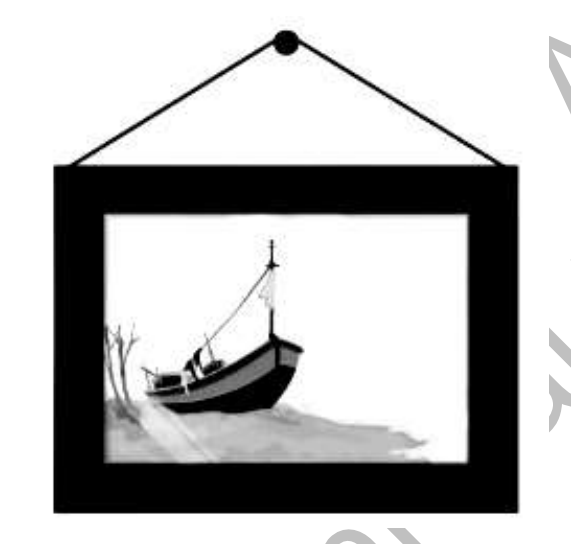
A hanging picture frame is in a state of static equilibrium. The picture frame has a mass of 0.3 kg0.3\text{ kg} and is suspended from a single point by a thin wire.
If a small object of 0.1 kg0.1\text{ kg} is hung at any one corner from the bottom of the picture frame, then explain how the addition of the small object affects the balance of these forces and the stability of the picture frame.
Diagram for Q.2
Checking Hints (Marking Scheme • 3 Marks)
  • 1 mark for explaining that hanging the 0.1 kg mass at one corner creates an unbalanced torque (moment) and disturbs the static equilibrium.
  • 1 mark for stating that the centre of gravity (CoG) of the picture frame shifts towards the weighted corner.
  • 1 mark for explaining that the frame tilts towards the weighted corner until the new centre of gravity aligns vertically below the suspension point, reducing its initial balanced stability.
✓ BETTER RESPONSE (SOLVED MODEL ANSWER)Full Marks (3/3)
1.Disturbance of Equilibrium (Unbalanced Torque): Initially, the picture frame is in static equilibrium because its centre of gravity lies vertically below the single suspension point. Hanging a 0.1 kg0.1\text{ kg} object at one bottom corner introduces an additional downward weight (W=mg=1 NW = mg = 1\text{ N}) at a distance from the line of action of tension, creating an unbalanced torque.
2.Shift in Centre of Gravity: The combined centre of gravity of the frame-and-mass system shifts away from the geometric centre towards the corner where the 0.1 kg0.1\text{ kg} mass is attached.
3.Effect on Position and Stability: Due to the unbalanced moment and shifted centre of gravity, the picture frame tilts downwards on the weighted side until the new centre of gravity comes to rest vertically below the point of suspension.
Q.3Section B: Constructed Response Questions (CRQs)
2025 Syllabus Outcome (3.3.1): explain Newton’s laws of motion;
Question Text
An apple falls on Earth due to the Earth’s attraction force. However, the Earth does not show movement towards the apple.
Describe the given phenomenon in TWO points.
Checking Hints (Marking Scheme • 2 Marks)
  • 1 mark for stating that by Newton's third law, the apple also exerts an equal and opposite gravitational attraction force on the Earth.
  • 1 mark for explaining that because the Earth's mass (and inertia) is enormously larger than the apple's mass (a = F/m), the Earth's acceleration towards the apple is imperceptibly small.
✓ BETTER RESPONSE (SOLVED MODEL ANSWER)Full Marks (2/2)
1.Equal and Opposite Gravitational Forces (Newton's Third Law): According to Newton's third law of motion (and universal gravitation), the Earth attracts the apple downwards towards its centre with a gravitational force, and the apple simultaneously attracts the Earth upwards with an equal and opposite reaction force (FEarth on apple=Fapple on EarthF_{\text{Earth on apple}} = F_{\text{apple on Earth}}).
2.**Effect of Mass and Inertia (a=F/ma = F/m):** Because acceleration is inversely proportional to mass (a=F/ma = F/m), the apple's very small mass experiences a large downward acceleration (9.8 m/s29.8\text{ m/s}^2), whereas the Earth's huge mass (6×1024 kg6 \times 10^{24}\text{ kg}) and enormous inertia result in an imperceptibly small acceleration towards the apple.
Q.4Section B: Constructed Response Questions (CRQs)
2025 Syllabus Outcome (8.2.9): explain that evaporation causes cooling;
Question Text
Describe in THREE points, how evaporation causes cooling.
Checking Hints (Marking Scheme • 3 Marks)
  • 1 mark for stating that molecules in a liquid move with different kinetic energies and the higher-kinetic-energy molecules at the surface escape into the air.
  • 1 mark for explaining that the departure of high-energy molecules lowers the average kinetic energy of the molecules left behind in the liquid.
  • 1 mark for explaining that during evaporation, latent heat is absorbed from the remaining liquid and surroundings, lowering the temperature and causing cooling.
✓ BETTER RESPONSE (SOLVED MODEL ANSWER)Full Marks (3/3)
1.Escape of High-Kinetic-Energy Molecules: In any liquid, molecules are in continuous random motion with a range of kinetic energies. During evaporation, the fastest-moving molecules near the surface possess enough kinetic energy to overcome intermolecular attractive forces and escape as vapour.
2.Decrease in Average Kinetic Energy: After the most energetic molecules escape, the molecules left behind in the liquid have a lower average kinetic energy.
3.Drop in Temperature and Heat Absorption: Since the temperature of a liquid is directly proportional to the average kinetic energy of its molecules (and evaporating molecules absorb latent heat of vaporisation from the liquid and its surroundings), the temperature of the remaining liquid decreases, producing a cooling effect.
Q.5Section B: Constructed Response Questions (CRQs)
2025 Syllabus Outcome (9.3.1): define the process of thermal energy transfer by radiation;
Question Text
Describe the transfer of heat through radiation in TWO points. Support your answer with an example.
Checking Hints (Marking Scheme • 3 Marks)
  • 1 mark for stating that thermal radiation transfers heat from one place to another by electromagnetic (infrared) waves.
  • 1 mark for stating that thermal radiation does not require any material medium and can travel through a vacuum.
  • 1 mark for giving a valid example (e.g., heat from the Sun reaching the Earth through space, or warmth felt from a heat lamp/fire).
✓ BETTER RESPONSE (SOLVED MODEL ANSWER)Full Marks (3/3)
1.Transfer via Electromagnetic Waves: Thermal radiation is the mode of heat transfer in which thermal energy is emitted and transmitted from a hot body in the form of electromagnetic waves (primarily infrared radiation).
2.No Material Medium Required: Unlike conduction and convection, radiation does not require any material medium of particles and can travel through a vacuum at the speed of light.
3.Example: Heat and light energy from the Sun reach the Earth across the vacuum of space through thermal radiation (or feeling warmth when sitting in front of a fireplace or electric heater).
Q.6.aSection C: Extended Response Questions (ERQs)
2025 Syllabus Outcome (2.4.1): interpret distance-time graph and speed-time graph;
Question Text
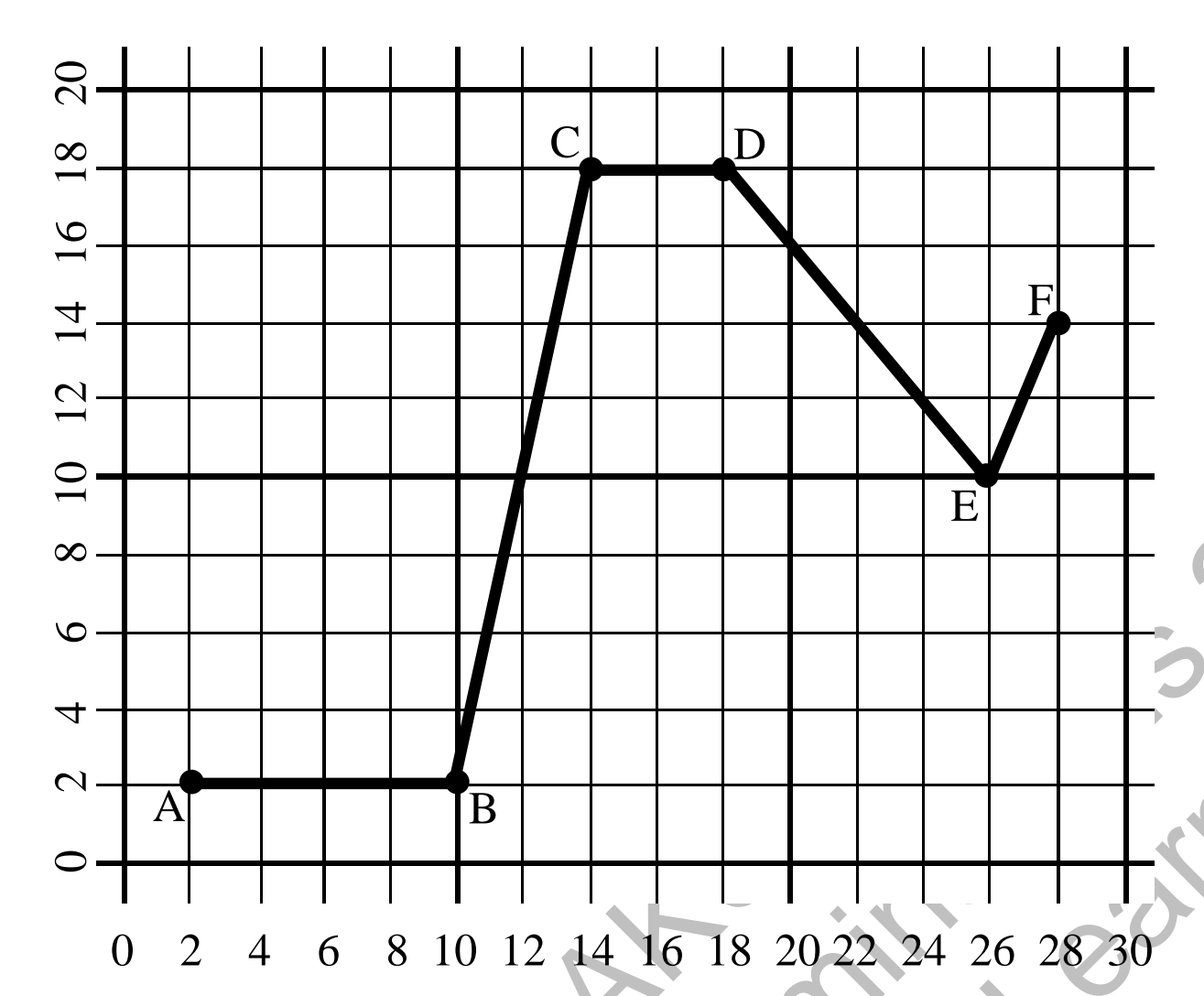
The following graph shows the path ABCDEF on which a boy walks.
Using the above graph calculate the
i.distance between A to B, B to C, C to D, D to E and E to F. (4 Marks)
ii.total distance covered. (1 Mark)
iii.total displacement covered. (1 Mark)
(Note: One small division is equal to one metre.)
Diagram for Q.6.a
Checking Hints (Marking Scheme • 6 Marks)
  • 1 mark for both stationary intervals: Distance covered during A to B = 0 m AND during C to D = 0 m.
  • 1 mark for distance covered during B to C: 18 m - 2 m = 16 m.
  • 1 mark for distance covered during D to E: 18 m - 10 m = 8 m.
  • 1 mark for distance covered during E to F: 14 m - 10 m = 4 m.
  • 1 mark for Total Distance covered = 0 + 16 + 0 + 8 + 4 = 28 m.
  • 1 mark for Total Displacement covered = 0 + 16 + 0 + (-8) + 4 = 12 m (or final position 14 m minus initial position 2 m = 12 m).
✓ BETTER RESPONSE (SOLVED MODEL ANSWER)Full Marks (6/6)
(i) Distance covered in each segment:
•From A to B: Position remains at 2 m2\text{ m}, so dAB=∣2−2∣=0 md_{AB} = |2 - 2| = 0\text{ m}
•From B to C: Position changes from 2 m2\text{ m} to 18 m18\text{ m}, so dBC=∣18−2∣=16 md_{BC} = |18 - 2| = 16\text{ m}
•From C to D: Position remains at 18 m18\text{ m}, so dCD=∣18−18∣=0 md_{CD} = |18 - 18| = 0\text{ m}
•From D to E: Position changes from 18 m18\text{ m} to 10 m10\text{ m}, so dDE=∣10−18∣=8 md_{DE} = |10 - 18| = 8\text{ m}
•From E to F: Position changes from 10 m10\text{ m} to 14 m14\text{ m}, so dEF=∣14−10∣=4 md_{EF} = |14 - 10| = 4\text{ m}
(ii) Total distance covered:
Total Distance=dAB+dBC+dCD+dDE+dEF=0+16+0+8+4=28 m\text{Total Distance} = d_{AB} + d_{BC} + d_{CD} + d_{DE} + d_{EF} = 0 + 16 + 0 + 8 + 4 = 28\text{ m}
(iii) Total displacement covered:
Total Displacement=0+16+0+(−8)+4=12 m\text{Total Displacement} = 0 + 16 + 0 + (-8) + 4 = 12\text{ m} (or xF−xA=14 m−2 m=12 mx_F - x_A = 14\text{ m} - 2\text{ m} = 12\text{ m}).
Q.6.bSection C: Extended Response Questions (ERQs)
2025 Syllabus Outcome (3.4.4): solve word problems related to momentum and impulse;
Question Text
A sports bicycle acquires a velocity of 25 m/s25\text{ m/s} from the state of rest when a force of 100 N100\text{ N} acts on it for 5 s5\text{ s}. Find
i.the mass of the bicycle. (4 Marks)
ii.the momentum of the bicycle after 5 s5\text{ s}. (2 Marks)
(Note: Extract data from the question and provide your answers in SI units.)
Checking Hints (Marking Scheme • 6 Marks)
  • 1 mark for extracting and writing the correct given data (v_i = 0 m/s, v_f = 25 m/s, F = 100 N, t = 5 s).
  • 1 mark for finding the correct acceleration using a = (v_f - v_i)/t = (25 - 0)/5 = 5 m/s².
  • 1 mark for writing the correct formula for mass: m = F / a (from F = ma).
  • 1 mark for calculating mass with correct SI unit: m = 100 / 5 = 20 kg.
  • 1 mark for writing the correct formula for momentum: P = m × v_f (or P = F × t).
  • 1 mark for calculating momentum with correct SI unit: P = 20 × 25 = 500 kg·m/s (or 500 N·s).
✓ BETTER RESPONSE (SOLVED MODEL ANSWER)Full Marks (6/6)
Given Data:
Initial velocity (viv_i) = 0 m/s0\text{ m/s}
Final velocity (vfv_f) = 25 m/s25\text{ m/s}
Force (FF) = 100 N100\text{ N}
Time (tt) = 5 s5\text{ s}
**(i) Mass of the bicycle (mm):**
First, find acceleration from the first equation of motion:
a=vf−vit=25−05=5 m/s2a = \frac{v_f - v_i}{t} = \frac{25 - 0}{5} = 5\text{ m/s}^2
By Newton's second law (F=maF = ma):
m=Fa=100 N5 m/s2=20 kgm = \frac{F}{a} = \frac{100\text{ N}}{5\text{ m/s}^2} = 20\text{ kg}
**(ii) Momentum of the bicycle after 5 s5\text{ s} (PP):**
P=m×vf=20 kg×25 m/s=500 kg⋅m/sP = m \times v_f = 20\text{ kg} \times 25\text{ m/s} = 500\text{ kg}\cdot\text{m/s} (or 500 N⋅s500\text{ N}\cdot\text{s}).
Q.7.aSection C: Extended Response Questions (ERQs)
2025 Syllabus Outcome (6.3.3): solve word problems related to the kinetic and potential energy;
Question Text
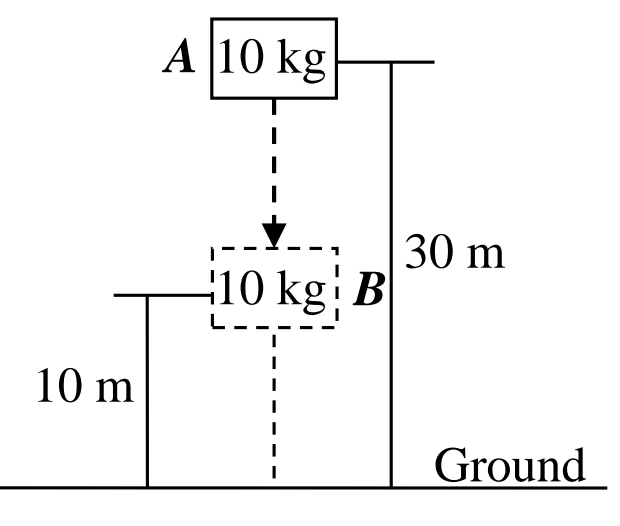
The diagram shows a block is dropped from a point A and moves to a point B.
i.Calculate the change in potential energy (P.E.) of the block at point B with respect to ground. (3 Marks)
ii.Calculate the velocity of the block when it reaches to the point B. (3 Marks)
(Note: Take the value of acceleration due to gravity 'gg' as 10 m/s210\text{ m/s}^2.)
Diagram for Q.7.a
Checking Hints (Marking Scheme • 6 Marks)
  • 1 mark for extracting the correct data: m = 10 kg, g = 10 m/s², vertical drop h = 30 m - 10 m = 20 m.
  • 1 mark for the correct potential energy formula: P.E. = mgh.
  • 1 mark for the correct change in potential energy from A to B: ΔP.E. = 10 × 10 × 20 = 2000 J.
  • 1 mark for equating loss in P.E. to gain in K.E. (K.E. = P.E.) or using 2gh = v_f² - v_i².
  • 1 mark for writing K.E. = ½mv² (or substituting into 2gh = v_f²).
  • 1 mark for the correct velocity at point B: v = √(2 × 10 × 20) = √400 = 20 m/s.
✓ BETTER RESPONSE (SOLVED MODEL ANSWER)Full Marks (6/6)
Given Data:
Mass of block (mm) = 10 kg10\text{ kg}
Height at point A (hAh_A) = 30 m30\text{ m}
Height at point B (hBh_B) = 10 m10\text{ m}
Vertical distance fallen from A to B (h=hA−hBh = h_A - h_B) = 30 m−10 m=20 m30\text{ m} - 10\text{ m} = 20\text{ m}
Acceleration due to gravity (gg) = 10 m/s210\text{ m/s}^2
**(i) Change in Potential Energy (ΔP.E.\Delta P.E.) of the block from A to B:**
ΔP.E.=mgh=10 kg×10 m/s2×(30−10) m=10×10×20=2000 J\Delta P.E. = mgh = 10\text{ kg} \times 10\text{ m/s}^2 \times (30 - 10)\text{ m} = 10 \times 10 \times 20 = 2000\text{ J}
*(Note: The potential energy remaining at point B with respect to the ground is P.E.B=mghB=10×10×10=1000 JP.E._B = mgh_B = 10 \times 10 \times 10 = 1000\text{ J}, and the loss/change in P.E. from A to B is 3000 J−1000 J=2000 J3000\text{ J} - 1000\text{ J} = 2000\text{ J}.)*
**(ii) Velocity of the block at point B (vfv_f):**
By conservation of energy (Gain in K.E.=Loss in P.E.\text{Gain in } K.E. = \text{Loss in } P.E.) or the third equation of motion (2gh=vf2−vi22gh = v_f^2 - v_i^2 with vi=0v_i = 0):
12mvf2=2000 J  ⟹  vf2=2×200010=400\frac{1}{2}mv_f^2 = 2000\text{ J} \implies v_f^2 = \frac{2 \times 2000}{10} = 400
vf=400=20 m/sv_f = \sqrt{400} = 20\text{ m/s}.
Q.7.bSection C: Extended Response Questions (ERQs)
2025 Syllabus Outcome (7.4.2): discuss the use of Pascal’s law (including hydraulic press and hydraulic brakes on vehicles);
Question Text
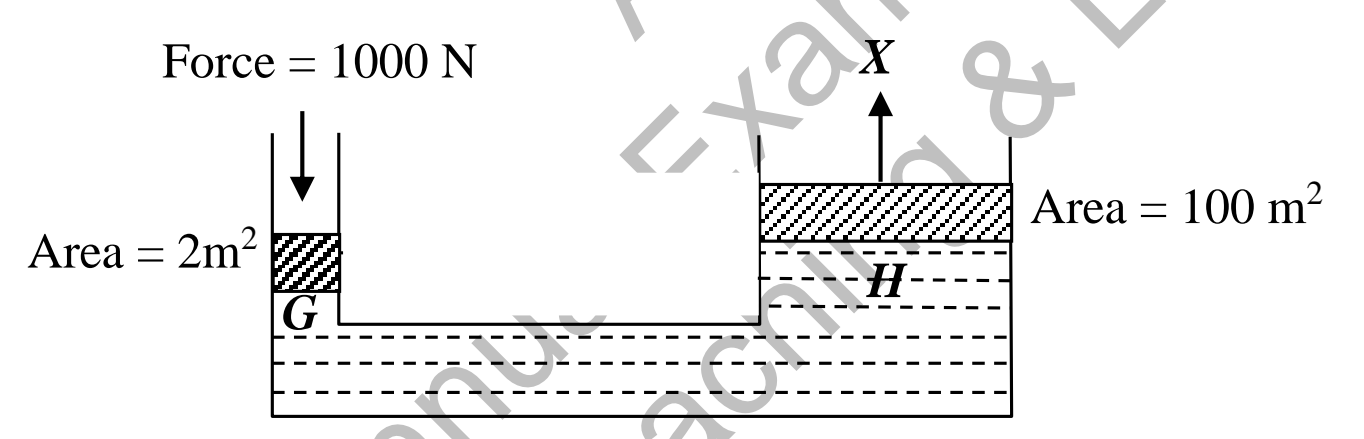
The given figure shows the brake system of a vehicle.
i.Name the law which is used in the given brake system. (1 Mark)
ii.Calculate the pressure exerted by the liquid at G and H and the force that is applied at X. (5 Marks)
Diagram for Q.7.b
Checking Hints (Marking Scheme • 6 Marks)
  • 1 mark for correctly identifying Pascal's law.
  • 1 mark for calculating pressure at G: P_G = F₁ / A₁ = 1000 N / 2 m² = 500 N/m² (or 500 Pa).
  • 1 mark for stating the pressure at H: P_H = 500 N/m² (or 500 Pa) because pressure is transmitted equally throughout an enclosed fluid.
  • 1 mark for using the correct transmitted pressure value P = 500 N/m².
  • 1 mark for writing the correct formula for force: F = P × A (or F₂ = P_H × A₂).
  • 1 mark for calculating the correct force at X: F = 500 × 100 = 50,000 N.
✓ BETTER RESPONSE (SOLVED MODEL ANSWER)Full Marks (6/6)
(i) Name of the law:
The law used in the hydraulic brake system of a vehicle is Pascal's law.
(ii) Pressure at G, Pressure at H, and Force at X:
•**Pressure exerted at piston G (PGP_G):**
PG=Force (F1)Area (A1)=1000 N2 m2=500 N/m2 (or 500 Pa)P_G = \frac{\text{Force }(F_1)}{\text{Area }(A_1)} = \frac{1000\text{ N}}{2\text{ m}^2} = 500\text{ N/m}^2\text{ (or }500\text{ Pa)}
•**Pressure exerted at piston H (PHP_H):**
According to Pascal's law, pressure applied to an enclosed liquid is transmitted undiminished to every portion of the liquid. Therefore:
PH=PG=500 N/m2 (or 500 Pa)P_H = P_G = 500\text{ N/m}^2\text{ (or }500\text{ Pa)}
•**Force applied at X (F2F_2):**
Since PH=F2A2P_H = \frac{F_2}{A_2}:
F2=PH×A2=500 N/m2×100 m2=50,000 NF_2 = P_H \times A_2 = 500\text{ N/m}^2 \times 100\text{ m}^2 = 50,000\text{ N}.