AKU-EBClass X (SSC Part II)CHAPTER-WISE ERQS • EXTENDED RESPONSE

Physics — Chapter-Wise Extended Response Questions (ERQs)

Practice 4–6 mark structured derivations, graph interpretations, and multi-part problems from 2024 & 2025 Annual Paper II, Model Paper II, and curriculum banks with official marking schemes and E-Marking scripts.

Back to Physics Subject Hub

Select a Chapter (or Browse All Below)

Click any unit card to filter to that specific chapter, or use the search bar to find any concept, formula, or SLO code.

UNIT 11 • 3 EXTENDED QUESTIONS (ERQS)

Unit 11: Wave Motion

2025 Syllabus Outcome (11.3.1): identify transverse and longitudinal waves in mechanical media;
EITHER (a):
Two different waves are shown in the given diagrams.
Identify the types of waves and describe any FOUR differences between these waves.
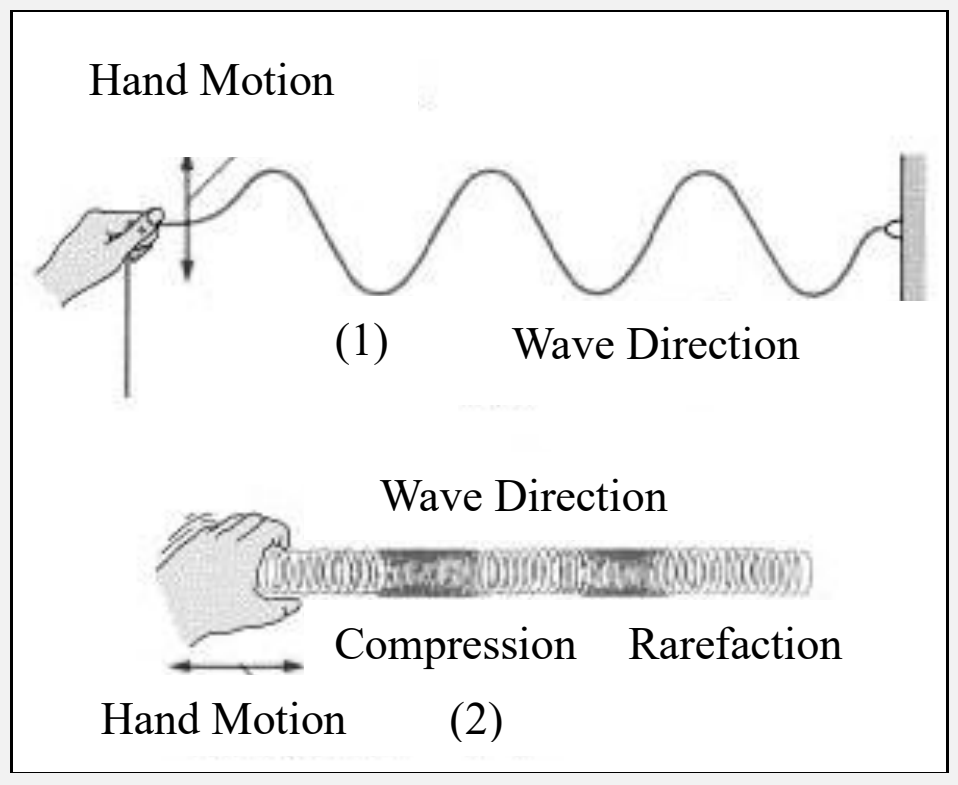
Diagram for Q.6.a
📋 Official Checking Hints (Marking Rubric • 6 Marks)
  • 1 mark for correctly identifying Wave (1) as a Transverse wave.
  • 1 mark for correctly identifying Wave (2) as a Longitudinal wave.
  • 1 mark for each correct point of difference between transverse and longitudinal waves (4 differences required = 4 marks).
✓ MODEL SOLUTION (Full Marks Guidance)
Identification of Waves (2 Marks):
•Diagram (1): Transverse Wave (rope wave where hand motion is perpendicular to wave direction).
•Diagram (2): Longitudinal Wave (slinky spring wave with compressions and rarefactions where hand motion is parallel to wave direction).
Four Differences Between Transverse and Longitudinal Waves (4 Marks):
FeatureTransverse Waves (1)Longitudinal Waves (2)
1. Direction of Particle VibrationParticles of the medium vibrate perpendicular (at right angles) to the direction of wave propagation.Particles of the medium vibrate parallel (back and forth along the same line) to the direction of wave propagation.
2. Waveform PatternConsist of alternating crests (high points) and troughs (low points).Consist of alternating compressions (high-density regions) and rarefactions (low-density regions).
**3. Definition of Wavelength (λ\lambda)**Distance between two consecutive crests or two consecutive troughs.Distance between the centres of two consecutive compressions or two consecutive rarefactions.
4. Medium & ExamplesCan travel through solids and liquid surfaces (and EM waves in vacuum); e.g., waves on a rope, water surface waves, light waves.Can travel through solids, liquids, and gases; e.g., sound waves in air, compressional waves on a slinky spring.

Examiner Commentary (Better Responses): Better responses correctly identified (1) as a Transverse Wave and (2) as a Longitudinal Wave, and used a structured two-column comparison table to highlight four clear differences (direction of particle vibration, crests/troughs vs. compressions/rarefactions, speed/medium, and examples).

⚠ WEAKER RESPONSE (Common Misconceptions & Lost Marks)
Weaker responses confused transverse/longitudinal waves with mechanical/electromagnetic waves (writing a table comparing Mechanical wave vs. Electromagnetic wave instead of identifying the two diagrams), or listed ultrasonic waves as transverse.
Examiner Suggestion for Improvement: Teachers are encouraged to use a slinky spring and rope in class to physically model transverse and longitudinal waves, contrasting particle vibration direction (perpendicular vs. parallel) and preventing students from mixing up wave classifications.
2025 Syllabus Outcome (11.1.3): solve word problems related to time period of a simple pendulum;
A simple pendulum is attached with 4 m long string.
i.Find the time period of the simple pendulum if it is placed in an elevator moving upwards with an acceleration of 8 m/s^2.
ii.If the elevator is moving downwards with an acceleration of 8 m/s^2, then what will be its time period?
(Note: The value of acceleration due to gravity 'g' is 9.8 m/s^2.)
📋 Official Checking Hints (Marking Rubric • 6 Marks)
  • Formula for time period of simple pendulum
  • Calculating effective 'g' for upward acceleration (g + a)
  • Correct calculation and unit for upward movement time period
  • Calculating effective 'g' for downward acceleration (g - a)
  • Correct calculation and unit for downward movement time period
  • Proper substitution and rounding in calculations
✓ MODEL SOLUTION (Full Marks Guidance)
Given: Length L = 4 m, g = 9.8 m/s^2, a = 8 m/s^2
i.Elevator moving upwards:
Effective gravity g' = g + a = 9.8 + 8 = 17.8 m/s^2
T = 2 * pi * sqrt(L / g') = 2 * 3.14 * sqrt(4 / 17.8) = 2.97 seconds.
ii.Elevator moving downwards:
Effective gravity g' = g - a = 9.8 - 8 = 1.8 m/s^2
T = 2 * pi * sqrt(L / g') = 2 * 3.14 * sqrt(4 / 1.8) = 9.36 seconds.
2025 Syllabus Outcome (11.1.3): solve word problems related to time period of a simple pendulum;
A simple pendulum is attached to a 4 m long string. Find its time period on Earth (g = 9.8 m/s²) and explain how the time period changes if the elevator accelerates upward or is on the Moon.
✓ MODEL SOLUTION (Full Marks Guidance)
On stationary Earth: T = 2π√(l/g) = 2π√(4 / 9.8) = 4.01 s. On the Moon (g_m = g/6), T increases by √6. In an upward-accelerating elevator (g_eff = g + a), T decreases.
UNIT 12 • 3 EXTENDED QUESTIONS (ERQS)

Unit 12: Sound

2025 Syllabus Outcome (12.4.2): describe ultrasound with examples;
OR (b):
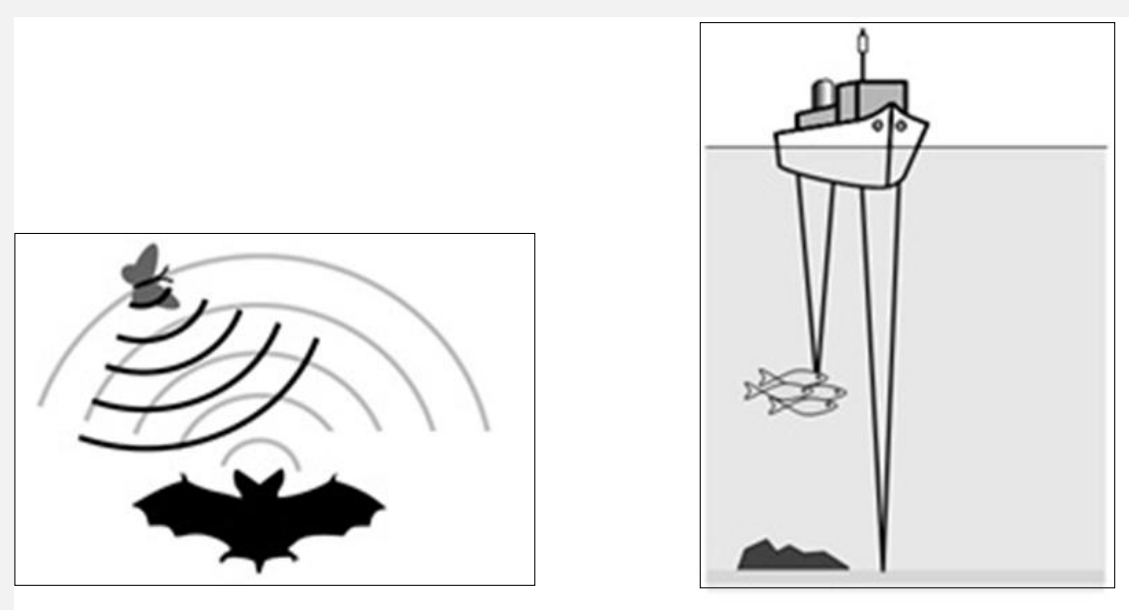
The given diagrams show two different uses of sound waves by two different things.
Identify the sound wave used in the given diagrams and describe any FIVE uses of that other than shown in the above diagrams.
Diagram for Q.6.b
📋 Official Checking Hints (Marking Rubric • 6 Marks)
  • i. 1 mark for correctly identifying the sound wave as Ultrasound (or Ultrasonic waves).
  • ii. 1 mark for EACH correct use of ultrasound other than bat echolocation and ship depth-sounding/fish-finding shown in the diagrams (Any 5 required = 5 marks).
✓ MODEL SOLUTION (Full Marks Guidance)
(i) Identification of Sound Wave (1 Mark):
The sound wave used in the given diagrams (bat echolocation and marine SONAR) is Ultrasound (ultrasonic waves with frequency above 20,000 Hz20,000\text{ Hz}).
(ii) Five Uses of Ultrasound Other Than Those Shown in the Diagrams (5 Marks):
1.Medical Diagnostic Imaging (Ultrasonography): Used to scan and visualize internal organs, monitor fetal development during pregnancy (obstetric ultrasound), and examine heart valves (echocardiography) safely without ionizing radiation.
2.Crushing Kidney Stones (Lithotripsy): High-intensity focused ultrasonic waves are directed at kidney stones or gallstones to shatter them into tiny sand-like fragments that pass out naturally.
3.Detecting Cracks and Flaws in Heavy Metal Components: Non-destructive testing (NDT) uses ultrasonic pulses to detect hidden internal cracks, voids, or cavities in aircraft wings, railway tracks, and heavy machinery shafts.
4.Ultrasonic Cleaning of Delicate Instruments: High-frequency ultrasonic vibrations in a cleaning liquid dislodge microscopic dirt and grease from jewellery, surgical instruments, watches, and electronic circuit boards.
5.Destroy Bacteria & Blood Clot Detection (Doppler Ultrasound): High-intensity ultrasound can sterilize liquids by destroying bacteria, and Doppler ultrasound measures blood flow speed to locate arterial blockages or blood clots.

Examiner Commentary (Better Responses): Better responses correctly identified the wave as Ultrasound and described five distinct applications (or sound wave properties in context), such as medical imaging, detecting kidney stones, finding cracks in metal structures, and ultrasonic cleaning.

⚠ WEAKER RESPONSE (Common Misconceptions & Lost Marks)
Weaker responses misidentified the diagrams as 'waves in a rope or string' and wrote about transverse and longitudinal waves, compressions, and rarefactions instead of ultrasound applications.
Examiner Suggestion for Improvement: Students should focus on distinguishing between everyday audible sound properties (loudness, pitch) and specialised high-frequency ultrasound applications in medicine and industry.
2025 Syllabus Outcome (12.3.1): describe an echo as the reflection of sound waves;
Ali produces a sound in a big empty hall. He hears a recurring sound resembling to his original sound.
i.Name and define the phenomenon of the sound wave that Ali observed.
ii.Explain how it is produced in FOUR points.
📋 Official Checking Hints (Marking Rubric • 6 Marks)
  • Naming the correct phenomenon (Echo)
  • Defining the echo phenomenon accurately
  • First point explaining production/reflection of sound wave
  • Second point explaining time interval or distance requirement
  • Third point explaining return of sound wave to listener
  • Fourth point explaining persistence of human hearing / distinction of sound
✓ MODEL SOLUTION (Full Marks Guidance)
i.Phenomenon: Echo.
Definition: The reflection of sound from a surface back to the listener, creating a repetition of the original sound.
ii.Explanation:
1.When Ali produces sound, sound waves travel outwards through the air in the hall.
2.These waves strike the hard, distant walls, floor, or ceiling of the big empty hall.
3.Upon striking, the sound waves bounce back (reflect) towards the source.
4.If the distance to the reflecting surface is sufficient, the reflected sound reaches Ali's ears at least 0.1 seconds after the original sound, allowing him to perceive it distinctly as an echo.
2025 Syllabus Outcome (12.3.1): describe an echo as the reflection of sound waves;
Ali produces a sound in a big empty hall and hears a recurring sound resembling his original sound. i. Name and define the phenomenon. ii. Explain how it is produced in FOUR points.
✓ MODEL SOLUTION (Full Marks Guidance)
i.Echo: The reflection of sound waves from a hard distant surface back to the listener. ii. 1. Sound waves travel outward from the source. 2. They strike a distant rigid wall (at least 17 m away in air). 3. Waves reflect back toward the listener. 4. Reflected sound arrives at least 0.1 s after the original sound (persistence of hearing).
UNIT 13 • 1 EXTENDED QUESTIONS (ERQS)

Unit 13: Geometrical Optics

2025 Syllabus Outcome (13.8.3): describe the correction of short-sightedness and long-sightedness using concave and convex lenses;
Describe short-sightedness (myopia) and long-sightedness (hypermetropia) in the human eye, stating the physical causes and the type of corrective lens required for each.
✓ MODEL SOLUTION (Full Marks Guidance)
Short-sightedness: distant objects focus in front of the retina due to elongated eyeball or excessive lens power; corrected with a diverging (concave) lens. Long-sightedness: near objects focus behind the retina due to shortened eyeball or weak lens; corrected with a converging (convex) lens.
UNIT 14 • 3 EXTENDED QUESTIONS (ERQS)

Unit 14: Electrostatics

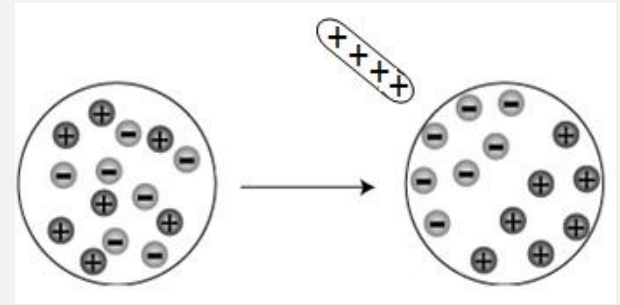
2025 Syllabus Outcome (14.3.1): describe the process of electrostatic induction;
EITHER (a):
i.Identify the phenomenon in the given diagram. (1 Mark)
ii.Write any FIVE hazards of the phenomenon identified in part (i). (5 Marks)
Diagram for Q.7.a
📋 Official Checking Hints (Marking Rubric • 6 Marks)
  • i. 1 mark for correctly identifying the phenomenon as Electrostatic Induction (or static electricity / charge separation by induction).
  • ii. 1 mark for each valid hazard of electrostatic charges / electrostatic induction (Any 5 required = 5 marks).
✓ MODEL SOLUTION (Full Marks Guidance)
(i) Identification of Phenomenon (1 Mark):
The phenomenon shown in the diagram is Electrostatic Induction (redistribution/separation of opposite charges on an insulated conductor when a charged rod is brought near it without touching).
(ii) Five Hazards of Electrostatic Charges / Electrostatic Induction (5 Marks):
1.Lightning Strikes: During thunderstorms, friction between water droplets and air currents builds up huge electrostatic charges in clouds, inducing opposite charges on the ground and tall buildings; sudden discharge produces lightning bolts that can cause fatal electrocution, structural damage, and forest fires.
2.Fires & Explosions During Aircraft Refuelling: As an aircraft flies through the air (or as fuel flows rapidly through refuelling pipes), static charge builds up by friction; an electrostatic spark near fuel vapour can ignite a catastrophic explosion unless the aircraft is earthed.
3.Igniting Flammable Vapours in Petrol Tankers & Fuel Stations: Friction between moving fuel/tyres and road surfaces charges fuel tankers; if not discharged via an earthing strap, an induced spark during unloading can ignite petrol vapours.
4.Damage to Sensitive Microelectronics & Computer Chips: Electrostatic discharge (ESD) from a person's body or clothing can permanently destroy delicate CMOS integrated circuits, transistors, and computer motherboards.
5.Explosion Hazard in Hospital Operating Theatres & Flour/Coal Mills: Static sparks in operating theatres using volatile anaesthetic gases or in environments with combustible dust/flammable gas can trigger explosions.

Examiner Commentary (Better Responses): Better responses accurately named 'electrostatic induction', defined how a charged rod separates unlike and like charges on a nearby conductor, and listed five concrete hazards such as sparks during petrol/gasoline pumping, friction charging of moving vehicles, and fire hazards near flammable gases.

⚠ WEAKER RESPONSE (Common Misconceptions & Lost Marks)
Weaker responses mislabeled the diagram as 'nuclear fusion', 'nuclear forces', or 'mutual induction', or described positive charges attracting negative charges through an earth wire without listing five hazards.
Examiner Suggestion for Improvement: Teachers should create side-by-side displays contrasting electrostatic induction with nuclear/magnetic concepts, and link hands-on static electricity demonstrations directly to real-world spark and fire hazards.
2025 Syllabus Outcome (14.4.3): identify different kinds of electrical lightning includes: a. ball lightning, b. elves, c. ghosts, d. jets, e. pixies, f. sprites, g. trolls;
i.Why large electrostatic charges can be dangerous? Give TWO examples of it from daily life.
ii.Long vehicles carrying inflammable materials usually have a metallic chain touching the ground during motion. Explain this statement using the phenomenon of electrostatic charges and friction.
📋 Official Checking Hints (Marking Rubric • 6 Marks)
  • Reason why large electrostatic charges are dangerous (sparking, fire, shocks)
  • First daily life example of electrostatic hazard
  • Second daily life example of electrostatic hazard
  • Explanation of friction causing charge accumulation on vehicles
  • Role of the metallic chain in safe discharge (earthing)
  • Prevention of explosion or fire hazards for inflammable materials
✓ MODEL SOLUTION (Full Marks Guidance)
i.Large electrostatic charges can cause sudden electrical discharges (sparks) that may lead to electric shocks, damage sensitive electronic components, or cause fires and explosions in flammable environments.
Examples: 1. Lightning strikes during thunderstorms. 2. Sparks produced while fueling aircraft or vehicles.
ii.Explanation: As long vehicles move, continuous friction between the air and the vehicle body, as well as between the tires and the road, causes static electricity to build up on the vehicle's surface. If allowed to accumulate, this static charge could discharge as a spark, which is extremely dangerous when carrying inflammable materials. To prevent this, a metallic chain touching the ground is used to safely conduct the accumulated charges directly into the Earth (earthing), neutralizing the static buildup.
2025 Syllabus Outcome (14.4.3): identify different kinds of electrical lightning includes: a. ball lightning, b. elves, c. ghosts, d. jets, e. pixies, f. sprites, g. trolls;
i.Why can large electrostatic charges be dangerous? Give TWO examples from daily life. ii. Why do long vehicles carrying inflammable materials touch the ground with metallic chains?
✓ MODEL SOLUTION (Full Marks Guidance)
i.Electrostatic discharge creates sparks that can ignite fuel vapours (e.g., aircraft refuelling sparks) or cause lightning strikes. ii. Metallic chains conduct accumulated static charge safely to the Earth (earthing), preventing sparks near inflammable vapour.
UNIT 15 • 2 EXTENDED QUESTIONS (ERQS)

Unit 15: Electric Current

2025 Syllabus Outcome (15.3.2): describe the following factors affecting the resistance of a metallic conductor: a. length of a conductor, b. cross-sectional area of a conductor, c. nature of a conductor, d. temperature of a conductor;
Explain how the resistance of a metallic conductor rises with an increase in temperature. Given FIVE points to support your answer.
📋 Official Checking Hints (Marking Rubric • 6 Marks)
  • First point: Atomic structure / positive ions vibration in metals
  • Second point: Effect of increased temperature on thermal energy and vibration amplitude
  • Third point: Increased frequency of collision between free electrons and vibrating ions
  • Fourth point: Obstruction to the flow of electric current / free electrons
  • Fifth point: Consequent increase in resistance with temperature rise
  • Clarity and scientific correctness of the overall explanation
✓ MODEL SOLUTION (Full Marks Guidance)
1.A metallic conductor consists of a lattice of positive ions through which free electrons move freely to conduct electricity.
2.At higher temperatures, the thermal energy of the metal increases, causing the positive ions to vibrate more violently about their mean positions with larger amplitudes.
3.As free electrons flow through the conductor under an electric field, they collide more frequently with these rapidly vibrating positive ions.
4.These frequent and intense collisions impede and scatter the flow of free electrons, increasing the obstruction to current flow.
5.Since electrical resistance is a measure of the opposition to the flow of current, this increased scattering and collision rate causes the resistance of the metallic conductor to rise as temperature increases.
2025 Syllabus Outcome (15.3.2): describe the following factors affecting the resistance of a metallic conductor: a. length of a conductor, b. cross-sectional area of a conductor, c. nature of a conductor, d. temperature of a conductor;
Explain how the resistance of a metallic conductor rises with an increase in temperature. Give FIVE points to support your answer.
✓ MODEL SOLUTION (Full Marks Guidance)
1.A metallic conductor contains positive metal ions and free conduction electrons. 2. Heating increases the thermal energy of the lattice ions. 3. Lattice ions vibrate with greater amplitude and frequency about their mean positions. 4. Free electrons drifting through the metal suffer more frequent collisions with vibrating ions. 5. Increased hindrance to electron drift reduces current for a given voltage, increasing resistance R.
UNIT 16 • 2 EXTENDED QUESTIONS (ERQS)

Unit 16: D.C. Circuits

2025 Syllabus Outcome (16.2.2): draw the circuit diagrams of the following electrical components: a. ammeters, b. batteries, c. cells, d. diodes, e. fuses, f. lamps, g. light-dependent resistors (LDRs), h. light-emitting diodes (LEDs), i. resistors (fixed and variable), j. switches, k. thermistors (NTC only), l. voltmeters;
OR (b):
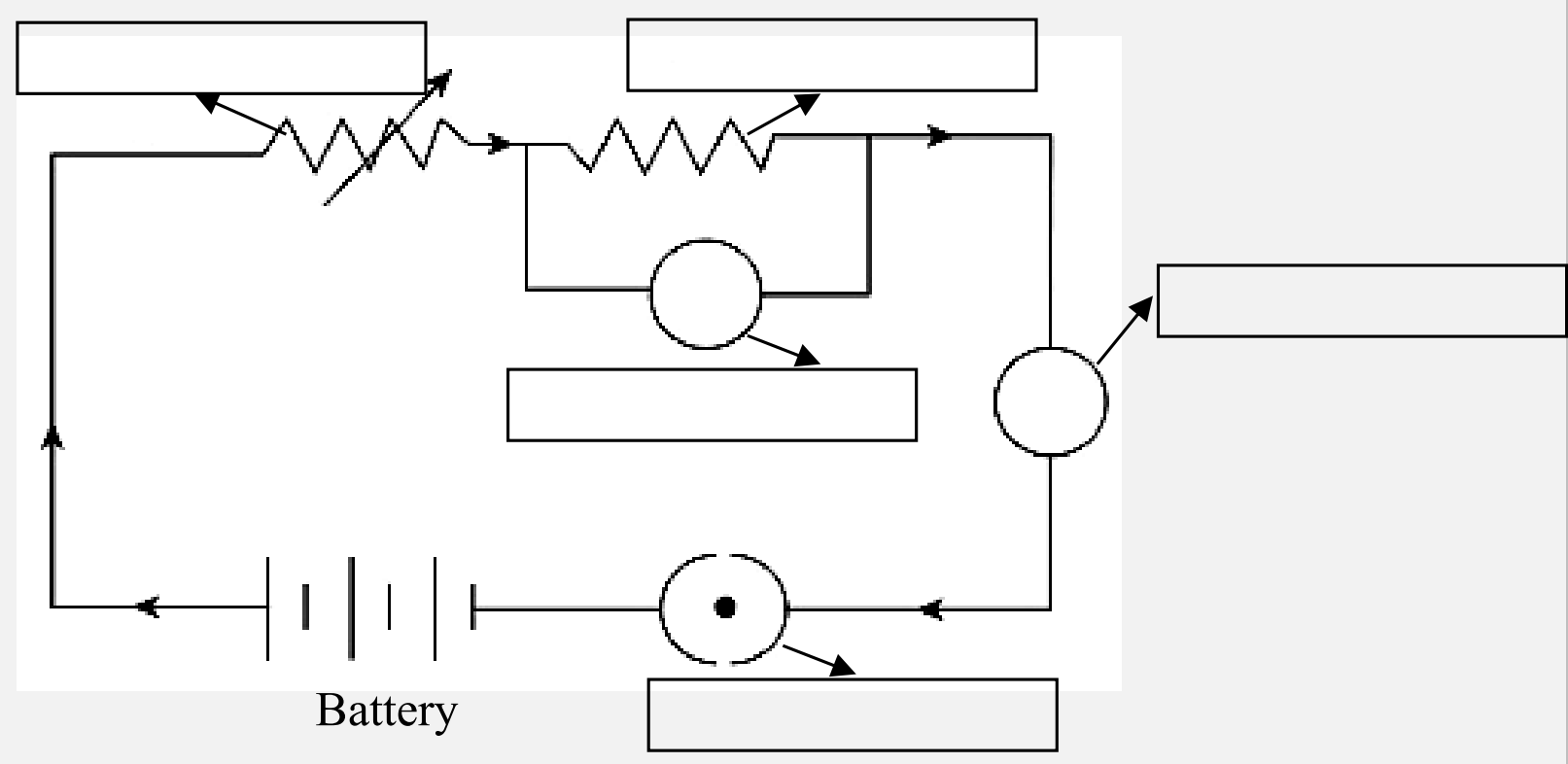
i.Label the electrical component in the given circuit diagram. (2 Marks)
ii.Describe any ONE use of the each of the identified electrical component in the given circuit diagram. (4 Marks)
Diagram for Q.7.b
📋 Official Checking Hints (Marking Rubric • 6 Marks)
  • i. 2 marks (1 mark for labelling any two parts; 4 parts required for full 2 marks): Variable Resistor (Rheostat), Fixed Resistor, Voltmeter (in parallel), Ammeter (in series), and Switch / Key.
  • ii. 4 marks (1 mark for writing the correct use of each of the 4 identified electrical components).
✓ MODEL SOLUTION (Full Marks Guidance)
(i) Labelling the Electrical Components in the Circuit Diagram (2 Marks):
•Top-Left Component (zigzag with arrow): Variable Resistor (Rheostat)
•Top-Middle Component (zigzag): Fixed Resistor
•Middle Circle (connected in parallel across fixed resistor): Voltmeter
•Right Circle (connected in series in main loop): Ammeter
•Bottom Circle (with central dot next to battery): Switch / Plug Key
(ii) Function / Use of Each Identified Electrical Component (4 Marks):
1.Switch / Key: Used to open (break) or close (complete) the electrical circuit to start or stop the flow of electric current safely.
2.Ammeter: Connected in series in the circuit to measure the magnitude of electric current flowing through the circuit (in amperes, A\text{A}).
3.Voltmeter: Connected in parallel across the fixed resistor to measure the potential difference (voltage) across the component (in volts, V\text{V}).
4.Fixed Resistor: Provides a constant, known opposition (resistance) to the flow of current to limit current or divide voltage in the circuit.
5.Variable Resistor (Rheostat): Allows the resistance in the circuit to be varied continuously so the electric current flowing through the circuit can be adjusted/controlled.

Examiner Commentary (Better Responses): Better responses accurately labelled all five boxes on the circuit diagram (Variable resistor, Fixed resistor, Voltmeter, Ammeter, and Switch/Key) and clearly stated the function and connection configuration (series vs. parallel) of each component.

⚠ WEAKER RESPONSE (Common Misconceptions & Lost Marks)
Weaker responses mislabelled the resistors as 'current', the voltmeter and ammeter circles as 'bulb', and the switch as 'capacitor', and wrote unrelated statements about solar panels charging batteries.
Examiner Suggestion for Improvement: Teachers are encouraged to create matching exercises with standard circuit symbols (resistor, rheostat, voltmeter in parallel, ammeter in series, plug key) to reinforce accurate device names and functions.
2025 Syllabus Outcome (16.1.3): calculate the effective/ equivalent resistance of resistors connected in series, parallel and both;
Derive the expressions for the equivalent resistance of three resistors R₁, R₂, and R₃ connected (a) in series and (b) in parallel.
✓ MODEL SOLUTION (Full Marks Guidance)
(a) Series: Same current I flows through each resistor, V = V₁ + V₂ + V₃ = I(R₁ + R₂ + R₃) => R_eq = R₁ + R₂ + R₃. (b) Parallel: Same voltage V across each branch, I = I₁ + I₂ + I₃ = V(1/R₁ + 1/R₂ + 1/R₃) => 1/R_eq = 1/R₁ + 1/R₂ + 1/R₃.
UNIT 17 • 1 EXTENDED QUESTIONS (ERQS)

Unit 17: Magnetism and Electromagnetism

2025 Syllabus Outcome (17.5.3): describe construction and working of a D.C. motor.
Explain the working principle of a D.C. motor and state four factors that increase the turning effect (magnetic torque) on its armature coil.
✓ MODEL SOLUTION (Full Marks Guidance)
A current-carrying coil in a magnetic field experiences equal and opposite forces on its two sides, forming a couple that rotates the coil; a split-ring commutator reverses current every half turn to maintain continuous rotation. Torque increases with: (1) larger current I, (2) stronger magnetic field B, (3) more turns N, and (4) larger coil area A.
UNIT 18 • 1 EXTENDED QUESTIONS (ERQS)

Unit 18: Electromagnetic Induction

2025 Syllabus Outcome (18.5.4): solve word problem using the transformer equation $\frac{V_s}{V_p} = \frac{I_p}{I_s} = \frac{N_s}{N_p}$;
State Faraday's law of electromagnetic induction and Lenz's law, and explain why electrical power is transmitted at very high voltage and low current across national grids.
✓ MODEL SOLUTION (Full Marks Guidance)
Faraday's law: Induced e.m.f. is directly proportional to the rate of change of magnetic flux linkage. Lenz's law: Direction of induced current opposes the change producing it. Since transmission line heating loss is P_loss = I²R, stepping up voltage reduces current I for a given power P = VI, drastically reducing I²R power loss.
UNIT 19 • 1 EXTENDED QUESTIONS (ERQS)

Unit 19: Electromagnetic Waves and Electronics

2025 Syllabus Outcome (19.5.7): describe the uses of logic gates.
Draw the circuit symbols and construct the complete truth tables for AND, OR, NOT, NAND, and NOR logic gates.
✓ MODEL SOLUTION (Full Marks Guidance)
AND outputs 1 only when both inputs are 1 (X = A·B); OR outputs 1 when at least one input is 1 (X = A+B); NOT inverts the input (X = Ā); NAND is inverted AND; NOR is inverted OR.
UNIT 20 • 1 EXTENDED QUESTIONS (ERQS)

Unit 20: Atomic and Nuclear Physics

2025 Syllabus Outcome (20.4.5): explain that an element may change into another element when radioactivity occurs;
Compare alpha (α), beta (β), and gamma (γ) radiations in terms of their nature, charge, ionising ability, penetrating power, and deflection in electric/magnetic fields.
✓ MODEL SOLUTION (Full Marks Guidance)
Alpha: Helium nucleus (²₄He²⁺), charge +2e, highest ionising power, lowest penetration (stopped by paper). Beta: Fast electron (⁰₋₁e), charge -e, moderate ionisation and penetration (stopped by a few mm of aluminium). Gamma: High-frequency electromagnetic photon, zero charge, lowest ionisation, highest penetration (attenuated by thick lead), undeflected by fields.