AKU-EBClass IX (SSC Part I)CHAPTER-WISE CRQS • SHORT RESPONSE

Physics — Chapter-Wise Constructed Response Questions (CRQs)

Master 2–3 mark short-answer conceptual questions from 2024 & 2025 Annual Examination Paper II, Model Paper II, and the 2025 syllabus, complete with Checking Hints rubrics, model solutions, and authentic E-Marking candidate scripts.

Back to Physics Subject Hub

Select a Chapter (or Browse All Below)

Click any unit card to filter to that specific chapter, or use the search bar to find any concept, formula, or SLO code.

UNIT 1 • 6 SHORT QUESTIONS (CRQS)

Unit 1: Measurement

2025 Syllabus Outcome (1.7.2): apply the rules for rounding a number to the appropriate number of significant figures.
An online purchasing company delivered a fragile item to its customer in a triangular box. The breadth and height of the box was 15 cm15\text{ cm} and 20 cm20\text{ cm} respectively.
Calculate the volume of the triangular box upto two significant figures.
(Note: Volume (V)=Breadth×Height\text{Volume }(V) = \text{Breadth} \times \text{Height})
📋 Official Checking Hints (Marking Rubric • 2 Marks)
  • 1 mark for writing the correct calculated answer: V = 15 cm × 20 cm = 300 cm² (or cm³).
  • 1 mark for rounding and writing the answer to two significant figures: 3.0 × 10² cm².
✓ MODEL SOLUTION (Full Marks Guidance)
Given Data:
Breadth (BB) = 15 cm15\text{ cm}
Height (HH) = 20 cm20\text{ cm}
Formula:
Volume (V)=Breadth×Height\text{Volume }(V) = \text{Breadth} \times \text{Height}
Calculation:
V=15 cm×20 cm=300 cm2V = 15\text{ cm} \times 20\text{ cm} = 300\text{ cm}^2
Rounding to two significant figures:
V=3.0×102 cm2V = 3.0 \times 10^2\text{ cm}^2 (where 33 and 00 are two significant figures).

Examiner Commentary (Better Responses): Better responses demonstrated a clear understanding of how to find the volume (V = 15 × 20 = 300 cm²) and then convert the answer into two significant figures (3.0 × 10² cm²), showing attention to detail and precision.

⚠ WEAKER RESPONSE (Common Misconceptions & Lost Marks)
Weaker responses lacked accuracy in either finding the volume (e.g., multiplying 15 × 15 = 225 and dividing by 20 to get 11.25 cm²) or converting the result into two significant figures.
Examiner Suggestion for Improvement: Subject teachers must focus carefully on the performance of their students in calculations and correctly applying the rules for significant figures to ensure accuracy in both the volume determination and the rounding process.
2025 Syllabus Outcome (1.7.1): describe significant figures;
How many significant figures are there in 0.0102030?
📋 Official Checking Hints (Marking Rubric • 1 Marks)
  • 1 mark for writing the correct number of significant figures (6 significant figures).
✓ MODEL SOLUTION (Full Marks Guidance)
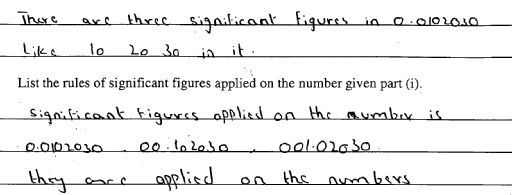
There are 6 significant figures in 0.0102030.

Examiner Commentary (Better Responses): Better responses correctly identified 6 significant figures in the given number and mentioned any ONE of the rules of significant figures: counting non-zero digits, recognising significant middle and trailing zeros, and excluding non-significant leading zeros.

Authentic E-Marking Better Candidate Script:
Better candidate script for Q.1.i
⚠ WEAKER RESPONSE (Common Misconceptions & Lost Marks)
Weak responses presented answers in a disorganised table format with irrelevant terms or suggested 'three significant figures' without proper justification, either omitting the trailing zero (resulting in 5) or mistakenly including leading zeros.
Authentic E-Marking Weaker Candidate Script:
Weaker candidate script for Q.1.i
Examiner Suggestion for Improvement: Focus on three key cases: leading zeros (never count), captive zeros (always count), and trailing zeros in decimals (always count). Use worked examples like 0.001 (1 sig fig), 202 (3 sig figs), and 3.00 (3 sig figs) to demonstrate rules consistently.
2025 Syllabus Outcome (1.7.1): describe significant figures;
List the rules of significant figures applied on the number given part (i).
📋 Official Checking Hints (Marking Rubric • 1 Marks)
  • 1 mark for stating any ONE valid rule of significant figures applied to 0.0102030.
✓ MODEL SOLUTION (Full Marks Guidance)
1.Leading zeros (zeros before the first non-zero digit) are not significant.
2.Zeros between non-zero digits are significant.
3.Trailing zeros after a decimal point are significant.

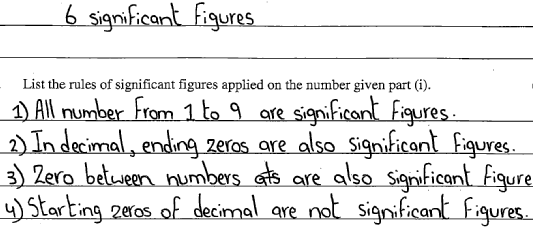
Examiner Commentary (Better Responses): Better responses correctly identified 6 significant figures in the given number and mentioned any ONE of the rules of significant figures: counting non-zero digits, recognising significant middle and trailing zeros, and excluding non-significant leading zeros.

Authentic E-Marking Better Candidate Script:
Better candidate script for Q.1.ii
⚠ WEAKER RESPONSE (Common Misconceptions & Lost Marks)
Weak responses presented answers in a disorganised table format with irrelevant terms or suggested 'three significant figures' without proper justification, either omitting the trailing zero (resulting in 5) or mistakenly including leading zeros.
Authentic E-Marking Weaker Candidate Script:
Weaker candidate script for Q.1.ii
Examiner Suggestion for Improvement: Focus on three key cases: leading zeros (never count), captive zeros (always count), and trailing zeros in decimals (always count). Use worked examples like 0.001 (1 sig fig), 202 (3 sig figs), and 3.00 (3 sig figs) to demonstrate rules consistently.
2025 Syllabus Outcome (1.5.1): identify measuring instruments;
Write the name of the physical quantity which is measured by the given instruments.
Diagram for Q.1
📋 Official Checking Hints (Marking Rubric • 2 Marks)
  • Correct identification of the first physical quantity
  • Correct identification of the second physical quantity
✓ MODEL SOLUTION (Full Marks Guidance)
Depends on the provided instrument diagrams in the original paper.
2025 Syllabus Outcome (1.7.1): describe significant figures;
i.How many significant figures are there in 0.0102030? ii. List the rules of significant figures applied.
✓ MODEL SOLUTION (Full Marks Guidance)
i.6 significant figures. ii. Leading zeros before the first non-zero digit are not significant; zeros between non-zero digits and trailing zeros in a decimal fraction are significant.
2025 Syllabus Outcome (1.5.2): determine the least count (LC) of the measuring instruments;
Write the name of the physical quantity measured by Vernier callipers and micrometer screw gauge, along with their typical least counts.
✓ MODEL SOLUTION (Full Marks Guidance)
Length / internal and external diameter (Vernier callipers least count = 0.01 cm or 0.1 mm; Micrometer screw gauge least count = 0.001 cm or 0.01 mm).
UNIT 2 • 1 SHORT QUESTIONS (CRQS)

Unit 2: Kinematics

2025 Syllabus Outcome (2.4.4): calculate the area under the speed-time graph of uniformly accelerated objects to find out the distance covered by the objects;
Explain how the distance travelled and acceleration of a moving body are determined from a speed–time graph.
✓ MODEL SOLUTION (Full Marks Guidance)
Acceleration is determined from the gradient (slope = Δv/Δt) of the speed–time graph, while total distance travelled equals the total area enclosed under the speed–time graph.
UNIT 3 • 5 SHORT QUESTIONS (CRQS)

Unit 3: Dynamics

2025 Syllabus Outcome (3.3.1): explain Newton’s laws of motion;
An apple falls on Earth due to the Earth’s attraction force. However, the Earth does not show movement towards the apple.
Describe the given phenomenon in TWO points.
📋 Official Checking Hints (Marking Rubric • 2 Marks)
  • 1 mark for stating that by Newton's third law, the apple also exerts an equal and opposite gravitational attraction force on the Earth.
  • 1 mark for explaining that because the Earth's mass (and inertia) is enormously larger than the apple's mass (a = F/m), the Earth's acceleration towards the apple is imperceptibly small.
✓ MODEL SOLUTION (Full Marks Guidance)
1.Equal and Opposite Gravitational Forces (Newton's Third Law): According to Newton's third law of motion (and universal gravitation), the Earth attracts the apple downwards towards its centre with a gravitational force, and the apple simultaneously attracts the Earth upwards with an equal and opposite reaction force (FEarth on apple=Fapple on EarthF_{\text{Earth on apple}} = F_{\text{apple on Earth}}).
2.**Effect of Mass and Inertia (a=F/ma = F/m):** Because acceleration is inversely proportional to mass (a=F/ma = F/m), the apple's very small mass experiences a large downward acceleration (9.8 m/s29.8\text{ m/s}^2), whereas the Earth's huge mass (6×1024 kg6 \times 10^{24}\text{ kg}) and enormous inertia result in an imperceptibly small acceleration towards the apple.

Examiner Commentary (Better Responses): In better responses, candidates clearly explained gravity and Newton's third law of motion, highlighting how the Earth's enormous mass and inertia cause its movement in response to the apple's gravitational pull to be negligible.

⚠ WEAKER RESPONSE (Common Misconceptions & Lost Marks)
Weaker responses failed to address how the Earth's huge mass results in negligible acceleration compared to the apple, or gave non-scientific explanations such as wind blowing the ripe apple off the tree.
Examiner Suggestion for Improvement: Classroom teaching should incorporate the concepts of inertia and gravitational force in conjunction with Newton's third law and second law (a = F/m), using everyday examples to illustrate how mass affects motion.
2025 Syllabus Outcome (3.2.3): identify the following forces as contact and non-contact forces: a. air resistance, b. drag force (push, pull), c. electrostatic force, d. force of friction, e. gravitational force, f. magnetic force, g. tension (elastic force), h. thrust (driving force);
The masses of the Earth and the Moon are 5.98×10245.98 \times 10^{24} kg and 7.35×10227.35 \times 10^{22} kg respectively. The distance between the Earth and the Moon is 3.84×1083.84 \times 10^8 m. The value of gravitational constant is 6.67×10−116.67 \times 10^{-11} Nm^2/kg^2. With reference to the given information, calculate the gravitational force exerted by the Earth on the Moon.
📋 Official Checking Hints (Marking Rubric • 2 Marks)
  • Correct substitution of values into Newton's law of gravitation formula
  • Correct calculation with proper unit
✓ MODEL SOLUTION (Full Marks Guidance)
F = G \times (m_1 \times m_2) / r^2 = (6.67×10−116.67 \times 10^{-11} \times 5.98×10245.98 \times 10^{24} \times 7.35×10227.35 \times 10^{22}) / (3.84×1083.84 \times 10^8)^2 \approx 1.99×10201.99 \times 10^{20} N
2025 Syllabus Outcome (3.4.1): define momentum with its units;
Find the momentum of the sports bike at the speed of 140 km/h.
📋 Official Checking Hints (Marking Rubric • 3 Marks)
  • Converting speed from km/h to m/s
  • Stating the formula for momentum (P = mv)
  • Correct calculation and unit for momentum
✓ MODEL SOLUTION (Full Marks Guidance)
Mass of bike (m) = 325 kg, Velocity (v) = 140 km/h = 140 \times 1000 / 3600 = 38.89 m/s. Momentum P = m \times v = 325 \times 38.89 = 12639.25 kg m/s.
2025 Syllabus Outcome (3.4.1): define momentum with its units;
Find the velocity of the car if momentum of both the vehicles is same.
📋 Official Checking Hints (Marking Rubric • 3 Marks)
  • Equating the momentum of car to the momentum of the bike
  • Rearranging the formula to solve for car's velocity
  • Correct calculation and unit for car's velocity
✓ MODEL SOLUTION (Full Marks Guidance)
Momentum of car = Momentum of bike = 12639.25 kg m/s. Mass of car = 1754 kg. Velocity of car = P / m = 12639.25 / 1754 = 7.21 m/s.
2025 Syllabus Outcome (3.5.2): differentiate between rolling friction and sliding friction;
Differentiate between rolling friction and sliding friction and explain why ball bearings are used in machinery.
✓ MODEL SOLUTION (Full Marks Guidance)
Rolling friction is much smaller than sliding friction because rolling avoids interlocking of surface irregularities over a large sliding area. Ball bearings convert sliding friction into rolling friction.
UNIT 4 • 4 SHORT QUESTIONS (CRQS)

Unit 4: Turning Effect of Forces

2025 Syllabus Outcome (4.4.4): explain different conditions of equilibrium with examples;
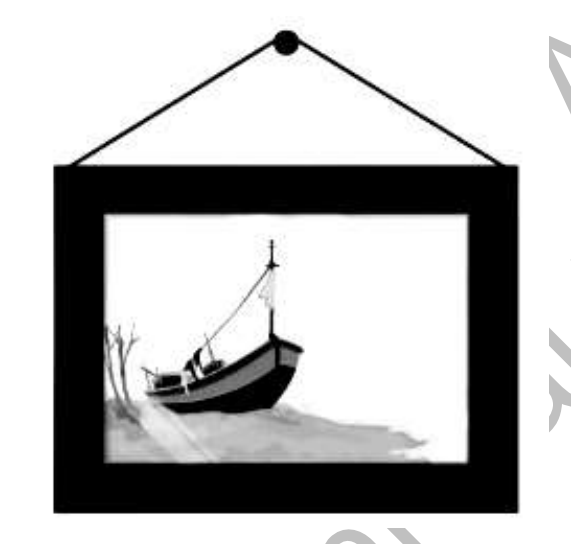
A hanging picture frame is in a state of static equilibrium. The picture frame has a mass of 0.3 kg0.3\text{ kg} and is suspended from a single point by a thin wire.
If a small object of 0.1 kg0.1\text{ kg} is hung at any one corner from the bottom of the picture frame, then explain how the addition of the small object affects the balance of these forces and the stability of the picture frame.
Diagram for Q.2
📋 Official Checking Hints (Marking Rubric • 3 Marks)
  • 1 mark for explaining that hanging the 0.1 kg mass at one corner creates an unbalanced torque (moment) and disturbs the static equilibrium.
  • 1 mark for stating that the centre of gravity (CoG) of the picture frame shifts towards the weighted corner.
  • 1 mark for explaining that the frame tilts towards the weighted corner until the new centre of gravity aligns vertically below the suspension point, reducing its initial balanced stability.
✓ MODEL SOLUTION (Full Marks Guidance)
1.Disturbance of Equilibrium (Unbalanced Torque): Initially, the picture frame is in static equilibrium because its centre of gravity lies vertically below the single suspension point. Hanging a 0.1 kg0.1\text{ kg} object at one bottom corner introduces an additional downward weight (W=mg=1 NW = mg = 1\text{ N}) at a distance from the line of action of tension, creating an unbalanced torque.
2.Shift in Centre of Gravity: The combined centre of gravity of the frame-and-mass system shifts away from the geometric centre towards the corner where the 0.1 kg0.1\text{ kg} mass is attached.
3.Effect on Position and Stability: Due to the unbalanced moment and shifted centre of gravity, the picture frame tilts downwards on the weighted side until the new centre of gravity comes to rest vertically below the point of suspension.

Examiner Commentary (Better Responses): Better responses clearly explained that adding weight to one corner shifts the frame's centre of gravity, causing an unbalanced moment so the frame tilts towards that corner and disturbs its initial static equilibrium.

⚠ WEAKER RESPONSE (Common Misconceptions & Lost Marks)
Weaker responses lacked detail on how the centre of gravity shifts, or confused the hanging wire with an Atwood pulley system and calculated acceleration a = (m₁ - m₂)g/(m₁ + m₂) and tension T = 2m₁m₂g/(m₁ + m₂).
Examiner Suggestion for Improvement: Using more teaching pedagogies with daily life examples can help deepen students' understanding of how hanging weight on one corner of a picture frame affects its position, centre of gravity, and stability.
2025 Syllabus Outcome (4.4.5): describe the states of equilibrium and classify them with common examples.
Describe the THREE states of equilibrium on the basis of centre of gravity.
📋 Official Checking Hints (Marking Rubric • 3 Marks)
  • Stable Equilibrium: Centre of gravity rises when tilted and body returns to original position.
  • Unstable Equilibrium: Centre of gravity lowers when tilted and body topples over.
  • Neutral Equilibrium: Centre of gravity remains at the same height and body remains in new position.
✓ MODEL SOLUTION (Full Marks Guidance)
1.Stable Equilibrium: A body is in stable equilibrium if, when slightly displaced, its centre of gravity rises and it returns to its original position.
2.Unstable Equilibrium: A body is in unstable equilibrium if, when slightly displaced, its centre of gravity lowers and it does not return to its original position but tumbles down.
3.Neutral Equilibrium: A body is in neutral equilibrium if, when displaced, its centre of gravity remains at the same height and it stays in its new position.

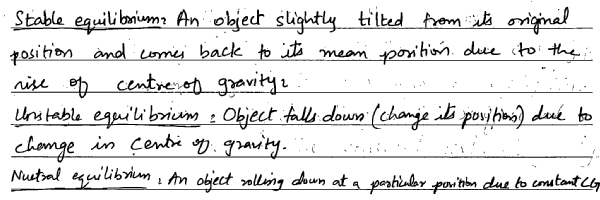
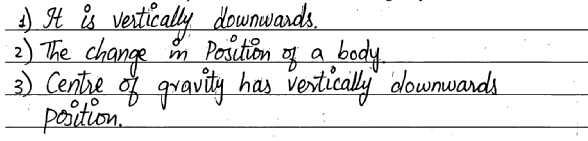
Examiner Commentary (Better Responses): Better responses correctly named stable, unstable, and neutral equilibrium and linked each to the centre of gravity: stable as returning to the original position (CoG rises then falls), unstable as toppling (CoG lowers), and neutral as maintaining CoG height.

Authentic E-Marking Better Candidate Script:
Better candidate script for Q.2
⚠ WEAKER RESPONSE (Common Misconceptions & Lost Marks)
Weaker responses listed vague statements such as 'It is vertically downwards' and 'The change in position of a body', which do not define stable, unstable, or neutral equilibrium.
Authentic E-Marking Weaker Candidate Script:
Weaker candidate script for Q.2
Examiner Suggestion for Improvement: Connect each equilibrium state to the behaviour of the centre of gravity when objects are displaced (e.g., a book for stable equilibrium, a pencil for unstable). Use diagrams showing how the height of the centre of gravity affects stability and restoring torque.
2025 Syllabus Outcome (4.4.4): explain different conditions of equilibrium with examples;
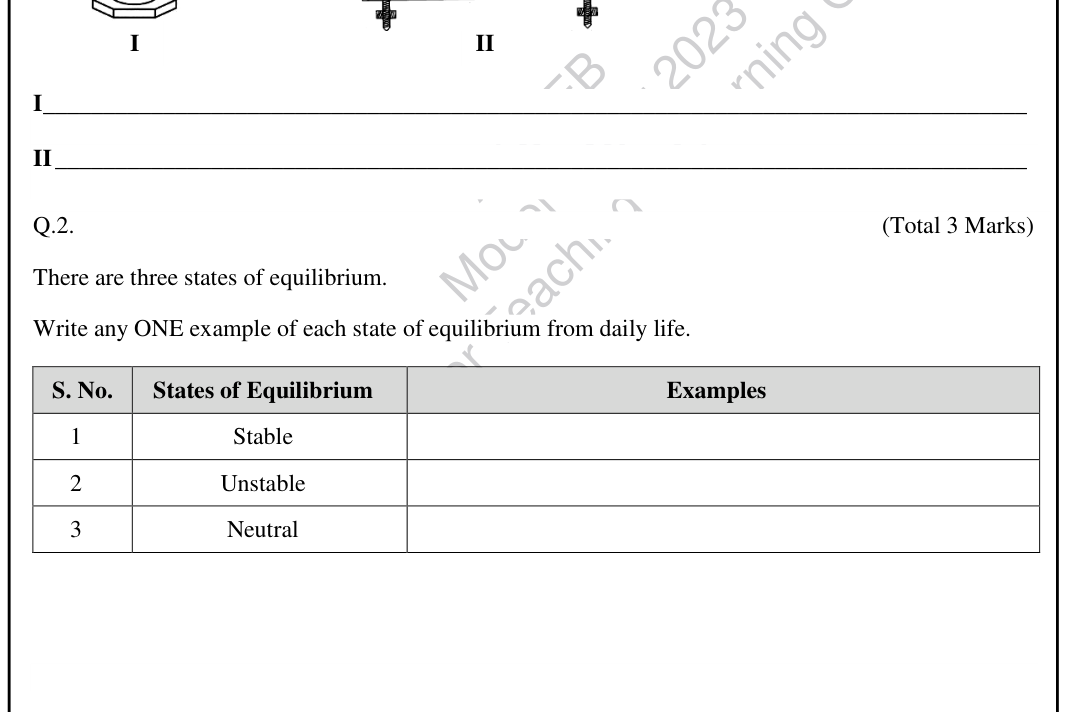
There are three states of equilibrium. Write any ONE example of each state of equilibrium from daily life.
📋 Official Checking Hints (Marking Rubric • 3 Marks)
  • Correct example for stable equilibrium
  • Correct example for unstable equilibrium
  • Correct example for neutral equilibrium
✓ MODEL SOLUTION (Full Marks Guidance)
Stable: A cone resting on its base. Unstable: A cone balancing on its apex. Neutral: A ball rolling on a flat surface.
2025 Syllabus Outcome (4.4.5): describe the states of equilibrium and classify them with common examples.
Describe the THREE states of equilibrium on the basis of the centre of gravity and give one daily-life example of each.
✓ MODEL SOLUTION (Full Marks Guidance)
1.Stable equilibrium: CoG rises on slight displacement and body returns to original position (e.g., book lying flat on a table). 2. Unstable equilibrium: CoG lowers on displacement and body topples (e.g., pencil balanced on its tip). 3. Neutral equilibrium: CoG height remains unchanged on displacement (e.g., rolling ball on a horizontal floor).
UNIT 5 • 2 SHORT QUESTIONS (CRQS)

Unit 5: Deformation of Solids

Q.32025 Annual Paper II ↗Out of 2025 Syllabus
Total 2 Marks • Level U
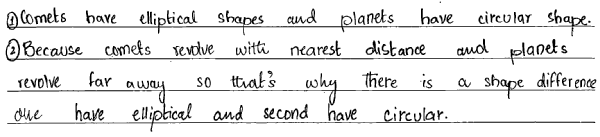
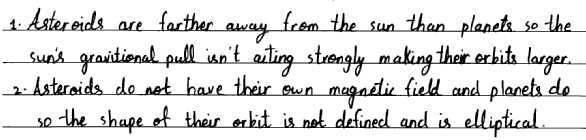
The orbits of comets are large and elliptical as compared to the orbits of planets which are smaller and circular. Describe the difference in the shapes of orbits with the help of TWO reasons.
📋 Official Checking Hints (Marking Rubric • 2 Marks)
  • Reason 1: Comets originate from outer solar system (Kuiper Belt/Oort Cloud) with high orbital eccentricity.
  • Reason 2: Planets formed in a protoplanetary disk under uniform gravitational pull leading to nearly circular orbits.
✓ MODEL SOLUTION (Full Marks Guidance)
1.Gravitational Influence: Planets are influenced primarily by the Sun's strong, consistent gravitational field at relatively close range, maintaining nearly circular orbits, whereas comets travel far into the outer solar system where gravitational forces vary greatly, leading to highly elongated elliptical paths.
2.Origin and Formation: Comets originate from the distant Oort cloud or Kuiper belt with random high-velocity vectors resulting in eccentric orbits, while planets formed within the protoplanetary disk in more stable, circularized paths.

Examiner Commentary (Better Responses): Better responses identified the highly eccentric elliptical paths of comets versus nearly circular planetary orbits and linked orbital shape to varying solar distance and gravitational pull.

Authentic E-Marking Better Candidate Script:
Better candidate script for Q.3
⚠ WEAKER RESPONSE (Common Misconceptions & Lost Marks)
Weaker responses attributed orbit size solely to distance from the Sun while overlooking orbital velocity and angular momentum, or inaccurately linked magnetic fields to orbit shape.
Authentic E-Marking Weaker Candidate Script:
Weaker candidate script for Q.3
Examiner Suggestion for Improvement: Use precise scientific terms (e.g., 'eccentric' for elliptical orbits) and clarify the role of gravitational forces. Emphasise how gravitational pull decreases with distance (inverse-square law) and how elliptical orbits result from velocity and position conditions.
2025 Syllabus Outcome (5.1.2): state Hooke’s law;
State Hooke's law and define the limit of proportionality on a load–extension graph.
✓ MODEL SOLUTION (Full Marks Guidance)
Hooke's law states that within the limit of proportionality, the extension of a spring is directly proportional to the applied stretching force (F = kx). The limit of proportionality is the point beyond which the load–extension graph ceases to be a straight line.
UNIT 6 • 1 SHORT QUESTIONS (CRQS)

Unit 6: Work, Energy and Power

2025 Syllabus Outcome (6.4.3): discuss that perpetual machines do not work;
Describe renewable and non-renewable sources of energy and give FOUR examples of each.
✓ MODEL SOLUTION (Full Marks Guidance)
Renewable sources are naturally replenished on a human timescale (solar, wind, hydroelectric, geothermal). Non-renewable sources exist in finite reserves and deplete with use (coal, petroleum, natural gas, uranium nuclear fuel).
UNIT 7 • 2 SHORT QUESTIONS (CRQS)

Unit 7: Pressure

2025 Syllabus Outcome (7.4.2): discuss the use of Pascal’s law (including hydraulic press and hydraulic brakes on vehicles);
Explain the reason, why upthrust acts in the upward direction.
📋 Official Checking Hints (Marking Rubric • 2 Marks)
  • Mentioning that pressure in a fluid increases with depth
  • Explaining that upward pressure at the bottom is greater than downward pressure at the top
✓ MODEL SOLUTION (Full Marks Guidance)
Pressure in a fluid increases with depth. Therefore, the upward force exerted by the fluid on the bottom of an immersed object is greater than the downward force exerted on the top, resulting in a net upward force called upthrust.
2025 Syllabus Outcome (7.4.2): discuss the use of Pascal’s law (including hydraulic press and hydraulic brakes on vehicles);
Explain why upthrust acts in the upward direction on an object immersed in a fluid.
✓ MODEL SOLUTION (Full Marks Guidance)
Hydrostatic pressure in a fluid increases with depth (P = ρgh). Consequently, the upward pressure on the bottom surface of an immersed object is greater than the downward pressure on its top surface, producing a net upward buoyant force (upthrust).
UNIT 8 • 4 SHORT QUESTIONS (CRQS)

Unit 8: Thermal Physics

2025 Syllabus Outcome (8.2.9): explain that evaporation causes cooling;
Describe in THREE points, how evaporation causes cooling.
📋 Official Checking Hints (Marking Rubric • 3 Marks)
  • 1 mark for stating that molecules in a liquid move with different kinetic energies and the higher-kinetic-energy molecules at the surface escape into the air.
  • 1 mark for explaining that the departure of high-energy molecules lowers the average kinetic energy of the molecules left behind in the liquid.
  • 1 mark for explaining that during evaporation, latent heat is absorbed from the remaining liquid and surroundings, lowering the temperature and causing cooling.
✓ MODEL SOLUTION (Full Marks Guidance)
1.Escape of High-Kinetic-Energy Molecules: In any liquid, molecules are in continuous random motion with a range of kinetic energies. During evaporation, the fastest-moving molecules near the surface possess enough kinetic energy to overcome intermolecular attractive forces and escape as vapour.
2.Decrease in Average Kinetic Energy: After the most energetic molecules escape, the molecules left behind in the liquid have a lower average kinetic energy.
3.Drop in Temperature and Heat Absorption: Since the temperature of a liquid is directly proportional to the average kinetic energy of its molecules (and evaporating molecules absorb latent heat of vaporisation from the liquid and its surroundings), the temperature of the remaining liquid decreases, producing a cooling effect.

Examiner Commentary (Better Responses): In better responses, candidates clearly explained that molecules of high kinetic energy escape through the surface of the liquid, leaving behind molecules of lower average kinetic energy and absorbing heat from the surroundings to cause cooling.

⚠ WEAKER RESPONSE (Common Misconceptions & Lost Marks)
In weaker responses, candidates focused only on defining evaporation or listing factors affecting evaporation, or attributed the cooling effect to loss/gain of electrons, thermal conductivity, or boiling.
Examiner Suggestion for Improvement: Teachers must emphasise the kinetic molecular explanation of evaporation, clearly linking the escape of high-energy surface molecules and latent heat absorption to the decrease in temperature.
2025 Syllabus Outcome (8.2.8): describe the process of evaporation and how it is different from boiling;
Write any THREE differences between evaporation and boiling.
📋 Official Checking Hints (Marking Rubric • 3 Marks)
  • Difference 1: Evaporation occurs at all temperatures, whereas boiling occurs only at a specific fixed boiling point.
  • Difference 2: Evaporation is a surface phenomenon; boiling is a bulk phenomenon occurring throughout the liquid.
  • Difference 3: Evaporation causes cooling; during boiling temperature remains constant.
✓ MODEL SOLUTION (Full Marks Guidance)
1.Evaporation takes place at all temperatures, whereas boiling takes place at a specific constant temperature (boiling point).
2.Evaporation is a surface phenomenon, whereas boiling is a bulk phenomenon.
3.Evaporation causes cooling, whereas boiling does not cause cooling.

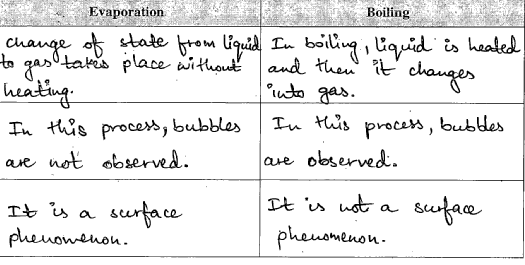
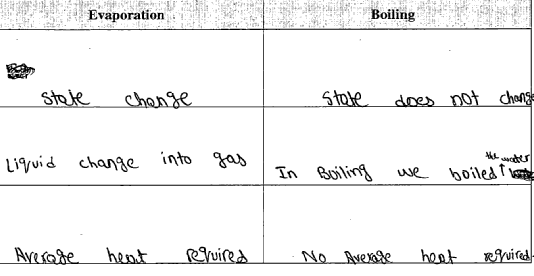
Examiner Commentary (Better Responses): Better responses highlighted three key scientific differences: (1) temperature requirement (boiling occurs at fixed boiling point while evaporation occurs at all temperatures), (2) bubble formation (absent in evaporation, present in boiling), and (3) surface vs. bulk phenomenon.

Authentic E-Marking Better Candidate Script:
Better candidate script for Q.4
⚠ WEAKER RESPONSE (Common Misconceptions & Lost Marks)
Weaker responses wrote vague statements like 'State change' vs 'State does not change' or confused states of matter (claiming boiling converts solid into liquid).
Authentic E-Marking Weaker Candidate Script:
Weaker candidate script for Q.4
Examiner Suggestion for Improvement: Use real-life examples (drying clothes vs. boiling water) to illustrate temperature dependence, bubble formation, and surface vs. bulk processes. Present differences in a parallel comparison table.
2025 Syllabus Outcome (8.2.9): explain that evaporation causes cooling;
The temperature of a metal rim is increased before fixing it to a wooden cartwheel. Give a scientific reason to support this statement.
📋 Official Checking Hints (Marking Rubric • 3 Marks)
  • Mentioning thermal expansion of metals on heating
  • Explaining that expansion allows the rim to easily fit over the wooden wheel
  • Stating that cooling causes contraction, gripping the wheel tightly
✓ MODEL SOLUTION (Full Marks Guidance)
When the metal rim is heated, it expands due to thermal expansion, making it slightly larger so it can easily slip over the wooden wheel. Upon cooling, it contracts and forms a tight fit around the wheel.
2025 Syllabus Outcome (8.2.9): explain that evaporation causes cooling;
The temperature of a metal rim is increased before fixing it onto a wooden cartwheel. Give a scientific reason.
✓ MODEL SOLUTION (Full Marks Guidance)
Heating causes thermal expansion of the metal rim, increasing its diameter so it slips easily over the wooden wheel; upon cooling, it contracts tightly onto the wheel.
UNIT 9 • 5 SHORT QUESTIONS (CRQS)

Unit 9: Transfer of Thermal Energy

2025 Syllabus Outcome (9.3.1): define the process of thermal energy transfer by radiation;
Describe the transfer of heat through radiation in TWO points. Support your answer with an example.
📋 Official Checking Hints (Marking Rubric • 3 Marks)
  • 1 mark for stating that thermal radiation transfers heat from one place to another by electromagnetic (infrared) waves.
  • 1 mark for stating that thermal radiation does not require any material medium and can travel through a vacuum.
  • 1 mark for giving a valid example (e.g., heat from the Sun reaching the Earth through space, or warmth felt from a heat lamp/fire).
✓ MODEL SOLUTION (Full Marks Guidance)
1.Transfer via Electromagnetic Waves: Thermal radiation is the mode of heat transfer in which thermal energy is emitted and transmitted from a hot body in the form of electromagnetic waves (primarily infrared radiation).
2.No Material Medium Required: Unlike conduction and convection, radiation does not require any material medium of particles and can travel through a vacuum at the speed of light.
3.Example: Heat and light energy from the Sun reach the Earth across the vacuum of space through thermal radiation (or feeling warmth when sitting in front of a fireplace or electric heater).

Examiner Commentary (Better Responses): Better responses described thermal radiation as heat transfer via electromagnetic waves without requiring any material medium, and supported the explanation with a clear example such as solar energy reaching the Earth.

⚠ WEAKER RESPONSE (Common Misconceptions & Lost Marks)
Weaker responses confused radiation with conduction in metals (e.g., claiming heat transfers in iron through radiation because iron is a good conductor of heat and electricity) or described evaporation and boiling.
Examiner Suggestion for Improvement: Encourage students to distinguish radiation (electromagnetic waves requiring no medium) from conduction in metals, and connect thermal radiation to real-world examples such as solar heating and infrared thermometers.
2025 Syllabus Outcome (9.1.4): solve word problems related to the thermal conductivity of solid conductors;
A copper rod is 20 m long with the cross-sectional area of 4 m2. If its two ends are kept at temperatures 200oC and 300oC respectively, calculate the amount of heat flowing across the rod in one second. (Note: Take the co-efficient of thermal conductivity as 386.4 J/m.K.s.)
📋 Official Checking Hints (Marking Rubric • 3 Marks)
  • Correct formula: Q/t = k * A * (T2 - T1) / L
  • Correct substitution: Q/t = 386.4 * 4 * (300 - 200) / 20
  • Correct calculation and units: Rate of heat flow = 7728 J/s (or Watts)
✓ MODEL SOLUTION (Full Marks Guidance)
Given data:
Length (LL) = 20 m
Area (AA) = 4 m2\text{m}^2
Temperature T1T_1 = 200 ∘C^{\circ}\text{C}, T2T_2 = 300 ∘C^{\circ}\text{C}
Temperature difference (ΔT\Delta T) = 300−200=100300 - 200 = 100 K
Time (tt) = 1 s
Coefficient of thermal conductivity (kk) = 386.4 J/m⋅K⋅s\text{J/m}\cdot\text{K}\cdot\text{s}
Formula:
Qt=k⋅A⋅(T2−T1)L\frac{Q}{t} = \frac{k \cdot A \cdot (T_2 - T_1)}{L}
Calculation:
Q1=386.4×4×10020\frac{Q}{1} = \frac{386.4 \times 4 \times 100}{20}
Q1=15456020=7728\frac{Q}{1} = \frac{154560}{20} = 7728 J/s
Amount of heat flowing in one second (QQ) = 7728 J

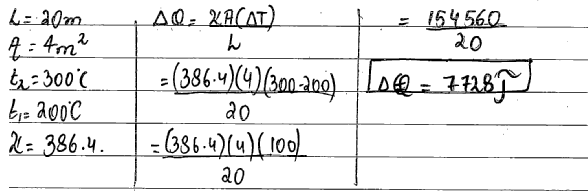
Examiner Commentary (Better Responses): Better responses applied Q/t = kAΔT / L and arrived at 7728 J with clear, logical steps and unit consistency.

Authentic E-Marking Better Candidate Script:
Better candidate script for Q.5
⚠ WEAKER RESPONSE (Common Misconceptions & Lost Marks)
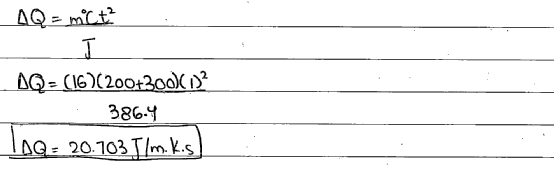
Weaker responses used invented formulas (such as ΔQ = m²t²/J) and mishandled units.
Authentic E-Marking Weaker Candidate Script:
Weaker candidate script for Q.5
Examiner Suggestion for Improvement: Highlight each variable's physical meaning in Q/t = kAΔT/L (k = thermal conductivity, A = cross-sectional area, ΔT = temperature difference, L = length). Emphasise unit consistency before substitution.
2025 Syllabus Outcome (9.1.3): describe the factors affecting the transfer of heat through solid conductors;
An animal fur coat is made in such a way that the inner surface of the material is the animal’s skin and the outer surface is fur/ hair. State the reason, why the coat is warmer if it is worn inside out (i.e. the inner surface becomes the outer)?
📋 Official Checking Hints (Marking Rubric • 1 Marks)
  • Explaining trapping of air or better insulation properties
✓ MODEL SOLUTION (Full Marks Guidance)
When worn inside out, the fur traps a larger layer of dead air close to the body, which acts as a better insulator and reduces heat loss.
2025 Syllabus Outcome (9.1.2): define the term ‘thermal conductivity’;
Walking barefoot on a carpet feels warmer than walking on tiles. Give a scientific reason to support this statement.
📋 Official Checking Hints (Marking Rubric • 2 Marks)
  • Identifying carpets as poor conductors (good insulators) and tiles as good conductors
  • Explaining heat transfer from feet to the surface
✓ MODEL SOLUTION (Full Marks Guidance)
Carpets are poor conductors of heat, so they do not conduct heat away from our feet. Tiles are better conductors of heat, conducting heat away from our feet rapidly, making them feel colder.
2025 Syllabus Outcome (9.1.2): define the term ‘thermal conductivity’;
Walking barefoot on a carpet feels warmer than walking on marble tiles in winter. Give a scientific reason.
✓ MODEL SOLUTION (Full Marks Guidance)
Tiles are much better thermal conductors than carpet fibres and rapidly conduct heat away from the bare feet, making the feet feel cold.
UNIT 10 • 1 SHORT QUESTIONS (CRQS)

Unit 10: Nature of Science

2025 Syllabus Outcome (10.3.1): define different scientific methods (hypothesis, theory and law) for carrying out investigations;
Differentiate between a scientific hypothesis, a theory, and a scientific law with an example from physics.
✓ MODEL SOLUTION (Full Marks Guidance)
A hypothesis is a testable tentative explanation of an observation; a theory is a well-substantiated explanation supported by repeated experiments (e.g., Kinetic Molecular Theory); a law is a concise mathematical or verbal statement of a universal relationship (e.g., Newton's Law of Gravitation).