AKU-EBClass IX (SSC Part I)CHAPTER-WISE NUMERICALS & WORKED PROBLEMS

Physics — Chapter-Wise Physics Numericals & Formula Applications

Step-by-step solved numerical word problems from 2024 & 2025 Annual Papers I & II, Model Papers I & II, and chapter formula banks, mapped to 2025 syllabus SLOs with SI units and KaTeX equations.

Back to Physics Subject Hub

Select a Chapter (or Browse All Below)

Click any unit card to filter to that specific chapter, or use the search bar to find any concept, formula, or SLO code.

UNIT 1 • 7 NUMERICAL PROBLEMS

Unit 1: Measurement — Worked Numericals

2025 Syllabus Outcome (1.7.2): apply the rules for rounding a number to the appropriate number of significant figures.
An online purchasing company delivered a fragile item to its customer in a triangular box. The breadth and height of the box was 15 cm15\text{ cm} and 20 cm20\text{ cm} respectively.
Calculate the volume of the triangular box upto two significant figures.
(Note: Volume (V)=Breadth×Height\text{Volume }(V) = \text{Breadth} \times \text{Height})
📋 Official Checking Hints (Marking Scheme):
  • 1 mark for writing the correct calculated answer: V = 15 cm × 20 cm = 300 cm² (or cm³).
  • 1 mark for rounding and writing the answer to two significant figures: 3.0 × 10² cm².
Given Data:
Breadth (BB) = 15 cm15\text{ cm}
Height (HH) = 20 cm20\text{ cm}
Formula:
Volume (V)=Breadth×Height\text{Volume }(V) = \text{Breadth} \times \text{Height}
Calculation:
V=15 cm×20 cm=300 cm2V = 15\text{ cm} \times 20\text{ cm} = 300\text{ cm}^2
Rounding to two significant figures:
V=3.0×102 cm2V = 3.0 \times 10^2\text{ cm}^2 (where 33 and 00 are two significant figures).
2025 Syllabus Outcome (1.7.2): apply the rules for rounding a number to the appropriate number of significant figures.
The volume of one small metallic cube is 1.76 cm³. Calculate the total volume of 21 such cubes and round the result to three significant figures.
Key Formula: V_total = 21 × V_1
V_total = 21 × 1.76 cm³ = 36.96 cm³. Rounded to 3 significant figures, V_total = 37.0 cm³.
2025 Syllabus Outcome (1.2.2): differentiate between base and derived physical quantities and units;
If the volume of the given cuboid is 0.03 m30.03\text{ m}^3, then the value of xx will be
The volume of a cuboid is V=l×w×hV = l \times w \times h. Substituting V=0.03 m3V = 0.03\text{ m}^3, l=0.5 ml = 0.5\text{ m}, and w=0.2 mw = 0.2\text{ m} gives 0.03=0.5×0.2×x=0.1x0.03 = 0.5 \times 0.2 \times x = 0.1x, so x=0.03/0.1=0.3 mx = 0.03 / 0.1 = 0.3\text{ m}.
2025 Syllabus Outcome (1.4.4): determine, using Pythagoras theorem and graphs, the resultant of two vectors at right angle;
A force of 10 N10\text{ N} is acting on a body along x-axis. The value of its y-component will be
Since the force acts entirely along the x-axis (θ=0∘\theta = 0^\circ), its y-component is Fy=Fsin⁡0∘=10×0=0 NF_y = F\sin 0^\circ = 10 \times 0 = 0\text{ N}.
2025 Syllabus Outcome (1.7.2): apply the rules for rounding a number to the appropriate number of significant figures.
If the volume of one cube is 1.76 cm31.76\text{ cm}^3, then the volume of twenty-one such cubes rounded off to three significant figures is
Total volume = 21 * 1.76 = 36.96 cm³. When rounded off to 3 significant figures, 36.96 becomes 37.0 cm³.
2025 Syllabus Outcome (1.3.2): convert numerical values of measurement in scientific notation;
The number 123.4 can also be written in scientific notation as
To express 123.4 in standard scientific notation (a×10na \times 10^n where 1≤∣a∣<101 \le |a| < 10), the decimal point is moved two places to the left, giving 1.234×1021.234 \times 10^2.
2025 Syllabus Outcome (1.4.4): determine, using Pythagoras theorem and graphs, the resultant of two vectors at right angle;
Two forces (9 N9\text{ N} and 12 N12\text{ N}) act at the right angle at point O, as shown in the given figure. What will be the magnitude and direction of the resultant force?
Magnitude R=92+122=81+144=225=15 NR = \sqrt{9^2 + 12^2} = \sqrt{81 + 144} = \sqrt{225} = 15\text{ N}. By vector addition (head-to-tail / parallelogram law), the resultant lies along OQ.
UNIT 2 • 8 NUMERICAL PROBLEMS

Unit 2: Kinematics — Worked Numericals

2025 Syllabus Outcome (2.4.1): interpret distance-time graph and speed-time graph;
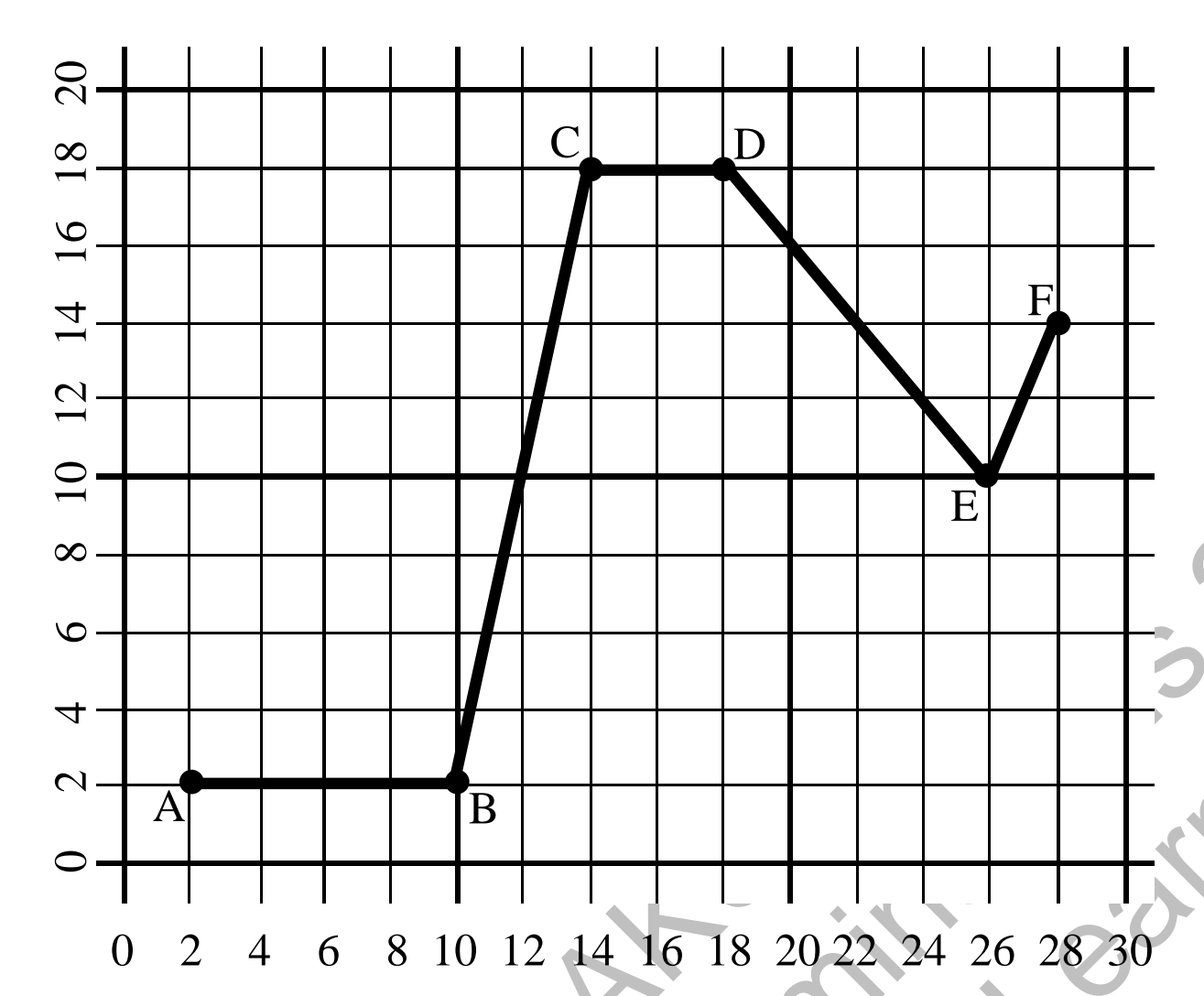
The following graph shows the path ABCDEF on which a boy walks.
Using the above graph calculate the
i.distance between A to B, B to C, C to D, D to E and E to F. (4 Marks)
ii.total distance covered. (1 Mark)
iii.total displacement covered. (1 Mark)
(Note: One small division is equal to one metre.)
Diagram for Q.6.a
📋 Official Checking Hints (Marking Scheme):
  • 1 mark for both stationary intervals: Distance covered during A to B = 0 m AND during C to D = 0 m.
  • 1 mark for distance covered during B to C: 18 m - 2 m = 16 m.
  • 1 mark for distance covered during D to E: 18 m - 10 m = 8 m.
  • 1 mark for distance covered during E to F: 14 m - 10 m = 4 m.
  • 1 mark for Total Distance covered = 0 + 16 + 0 + 8 + 4 = 28 m.
  • 1 mark for Total Displacement covered = 0 + 16 + 0 + (-8) + 4 = 12 m (or final position 14 m minus initial position 2 m = 12 m).
(i) Distance covered in each segment:
•From A to B: Position remains at 2 m2\text{ m}, so dAB=∣2−2∣=0 md_{AB} = |2 - 2| = 0\text{ m}
•From B to C: Position changes from 2 m2\text{ m} to 18 m18\text{ m}, so dBC=∣18−2∣=16 md_{BC} = |18 - 2| = 16\text{ m}
•From C to D: Position remains at 18 m18\text{ m}, so dCD=∣18−18∣=0 md_{CD} = |18 - 18| = 0\text{ m}
•From D to E: Position changes from 18 m18\text{ m} to 10 m10\text{ m}, so dDE=∣10−18∣=8 md_{DE} = |10 - 18| = 8\text{ m}
•From E to F: Position changes from 10 m10\text{ m} to 14 m14\text{ m}, so dEF=∣14−10∣=4 md_{EF} = |14 - 10| = 4\text{ m}
(ii) Total distance covered:
Total Distance=dAB+dBC+dCD+dDE+dEF=0+16+0+8+4=28 m\text{Total Distance} = d_{AB} + d_{BC} + d_{CD} + d_{DE} + d_{EF} = 0 + 16 + 0 + 8 + 4 = 28\text{ m}
(iii) Total displacement covered:
Total Displacement=0+16+0+(−8)+4=12 m\text{Total Displacement} = 0 + 16 + 0 + (-8) + 4 = 12\text{ m} (or xF−xA=14 m−2 m=12 mx_F - x_A = 14\text{ m} - 2\text{ m} = 12\text{ m}).
2025 Syllabus Outcome (2.5.2): solve word problems related to free-falling bodies using the relation g = Δv/ Δt.
Zohan dropped a ball from a certain height. Its final velocity becomes 25 m/s when it reaches the ground. Now from the same height, if he throws the ball vertically downward with an initial velocity of 25 m/s, then calculate its final velocity. (Note: Take the value of acceleration due to gravity as 9.8 m/s2.)
📋 Official Checking Hints (Marking Scheme):
  • Using appropriate equation of motion: v_f^2 = v_i^2 + 2gh or v_f = gt
  • Correct substitution and final numerical answer with units (m/s).
First scenario:
Initial velocity (viv_i) = 0 m/s
Final velocity (vfv_f) = 25 m/s
Acceleration (gg) = 9.8 m/s2\text{m/s}^2
Using third equation of motion:
vf2=vi2+2gsv_f^2 = v_i^2 + 2gs
(25)2=(0)2+2(9.8)s(25)^2 = (0)^2 + 2(9.8)s
625=19.6s625 = 19.6s
s=62519.6≈31.89s = \frac{625}{19.6} \approx 31.89 m
Second scenario:
Initial velocity (viv_i) = 25 m/s
Distance (ss) = 31.89 m
Acceleration (gg) = 9.8 m/s2\text{m/s}^2
Using third equation of motion:
vf2=vi2+2gsv_f^2 = v_i^2 + 2gs
vf2=(25)2+2(9.8)(31.89)v_f^2 = (25)^2 + 2(9.8)(31.89)
vf2=625+625=1250v_f^2 = 625 + 625 = 1250
vf=1250≈35.36v_f = \sqrt{1250} \approx 35.36 m/s
2025 Syllabus Outcome (2.3.4): describe the universal speed limit of any object in the universe that is approximately 3 × 10⁸ m/s;
A sports car starts from rest. It covers a distance of 900 m to attain a speed of 80 m/s. Determine the acceleration of the car and the time required to reach this speed.
📋 Official Checking Hints (Marking Scheme):
  • Identifying given data (v_i = 0, v_f = 80 m/s, S = 900 m)
  • Using third equation of motion to find acceleration
  • Correct value of acceleration with units
  • Using first or second equation of motion to find time
  • Correct value of time with units
Given: v_i = 0 m/s, v_f = 80 m/s, S = 900 m. Using 2aS = v_f^2 - v_i^2 => 2a(900) = (80)^2 - 0 => 1800a = 6400 => a = 3.56 m/s^2. Using v_f = v_i + at => 80 = 0 + (3.56)t => t = 22.48 s.
2025 Syllabus Outcome (2.5.2): solve word problems related to free-falling bodies using the relation g = Δv/ Δt.
A cricket ball is hit vertically upward and reaches its maximum height in 3 s. Calculate its initial velocity (g = 9.8 m/s²).
Key Formula: v_f = v_i - gt
At maximum height, v_f = 0 m/s. Therefore v_i = g × t = 9.8 m/s² × 3 s = 29.4 m/s.
2025 Syllabus Outcome (2.3.2): calculate average speed, average velocity and acceleration;
A body starts from rest and accelerates to a velocity of 100 m/s100\text{ m/s}. If it covers a distance of 50 m50\text{ m}, then its acceleration will be
Using the third equation of motion 2aS=vf2−vi22aS = v_f^2 - v_i^2 with vi=0v_i = 0, vf=100 m/sv_f = 100\text{ m/s}, and S=50 mS = 50\text{ m} gives 2a(50)=1002⇒100a=10000⇒a=100 m/s22a(50) = 100^2 \Rightarrow 100a = 10000 \Rightarrow a = 100\text{ m/s}^2.
2025 Syllabus Outcome (2.3.2): calculate average speed, average velocity and acceleration;
If a motorcyclist covers a displacement of 150 m150\text{ m} in 10 s10\text{ s}, then his/ her velocity will be
Velocity is the rate of change of displacement: v=dt=150 m10 s=15 m/sv = \frac{d}{t} = \frac{150\text{ m}}{10\text{ s}} = 15\text{ m/s}.
2025 Syllabus Outcome (2.5.2): solve word problems related to free-falling bodies using the relation g = Δv/ Δt.
A child drops a tennis ball from a height of 10 m10\text{ m}. The velocity of the ball just before it strikes the ground will be
(Note: The value of acceleration due to gravity is 9.8 m/s29.8\text{ m/s}^2.)
Using the equation of motion v2=u2+2asv^2 = u^2 + 2as, where u=0u = 0, a=9.8 m/s2a = 9.8\text{ m/s}^2, and s=10 ms = 10\text{ m}: v2=0+2(9.8)(10)=196v^2 = 0 + 2(9.8)(10) = 196, so v=196=14.0 m/sv = \sqrt{196} = 14.0\text{ m/s}.
2025 Syllabus Outcome (2.3.2): calculate average speed, average velocity and acceleration;
The given table shows the distance covered by a car on a straight road in four different segments.
SegmentDistance CoveredNotes / Displacement
Segment I0-10 m-
Segment II11-22 mdisplacement = 11 m
Segment III23-35 mdisplacement = 12 m
Segment IV36-49 mdisplacement = 13 m
If the car takes same interval of time to cover all four segments, then the car
The distance covered in equal time intervals increases in each subsequent segment (10 m, 11 m, 12 m, 13 m), meaning the speed is increasing, hence the car is accelerating.
UNIT 3 • 10 NUMERICAL PROBLEMS

Unit 3: Dynamics — Worked Numericals

2025 Syllabus Outcome (3.4.4): solve word problems related to momentum and impulse;
A sports bicycle acquires a velocity of 25 m/s25\text{ m/s} from the state of rest when a force of 100 N100\text{ N} acts on it for 5 s5\text{ s}. Find
i.the mass of the bicycle. (4 Marks)
ii.the momentum of the bicycle after 5 s5\text{ s}. (2 Marks)
(Note: Extract data from the question and provide your answers in SI units.)
📋 Official Checking Hints (Marking Scheme):
  • 1 mark for extracting and writing the correct given data (v_i = 0 m/s, v_f = 25 m/s, F = 100 N, t = 5 s).
  • 1 mark for finding the correct acceleration using a = (v_f - v_i)/t = (25 - 0)/5 = 5 m/s².
  • 1 mark for writing the correct formula for mass: m = F / a (from F = ma).
  • 1 mark for calculating mass with correct SI unit: m = 100 / 5 = 20 kg.
  • 1 mark for writing the correct formula for momentum: P = m × v_f (or P = F × t).
  • 1 mark for calculating momentum with correct SI unit: P = 20 × 25 = 500 kg·m/s (or 500 N·s).
Given Data:
Initial velocity (viv_i) = 0 m/s0\text{ m/s}
Final velocity (vfv_f) = 25 m/s25\text{ m/s}
Force (FF) = 100 N100\text{ N}
Time (tt) = 5 s5\text{ s}
**(i) Mass of the bicycle (mm):**
First, find acceleration from the first equation of motion:
a=vf−vit=25−05=5 m/s2a = \frac{v_f - v_i}{t} = \frac{25 - 0}{5} = 5\text{ m/s}^2
By Newton's second law (F=maF = ma):
m=Fa=100 N5 m/s2=20 kgm = \frac{F}{a} = \frac{100\text{ N}}{5\text{ m/s}^2} = 20\text{ kg}
**(ii) Momentum of the bicycle after 5 s5\text{ s} (PP):**
P=m×vf=20 kg×25 m/s=500 kg⋅m/sP = m \times v_f = 20\text{ kg} \times 25\text{ m/s} = 500\text{ kg}\cdot\text{m/s} (or 500 N⋅s500\text{ N}\cdot\text{s}).
2025 Syllabus Outcome (3.4.2): explain the relationship between force and momentum;
State and explain Newton’s 2nd law of motion and prove that the rate of change of momentum is equal to force.
📋 Official Checking Hints (Marking Scheme):
  • Statement: Acceleration is directly proportional to applied net force and inversely proportional to mass.
  • Mathematical derivation showing a ∝ F and a ∝ 1/m leading to F = ma.
  • Definition of unit force: 1 Newton is force required to produce 1 m/s² acceleration in 1 kg mass.
Statement: When a net force acts on a body, it produces acceleration in the direction of the force. The acceleration is directly proportional to the net force and inversely proportional to the mass of the body.
Explanation and Proof:
Let a body of mass 'mm' move with initial velocity 'viv_i'. Let a force 'FF' act on it for time 'tt' so that its velocity becomes 'vfv_f' .
Initial momentum (PiP_i) = mvimv_i
Final momentum (PfP_f) = mvfmv_f
Change in momentum = Pf−Pi=mvf−mvi=m(vf−vi)P_f - P_i = mv_f - mv_i = m(v_f - v_i)
Rate of change of momentum = m(vf−vi)t\frac{m(v_f - v_i)}{t}
Since acceleration a=vf−vita = \frac{v_f - v_i}{t},
Rate of change of momentum = mama
According to Newton's second law, F=maF = ma.
Therefore, F=Rate of change of momentumF = \text{Rate of change of momentum}.
2025 Syllabus Outcome (3.2.3): identify the following forces as contact and non-contact forces: a. air resistance, b. drag force (push, pull), c. electrostatic force, d. force of friction, e. gravitational force, f. magnetic force, g. tension (elastic force), h. thrust (driving force);
The masses of the Earth and the Moon are 5.98×10245.98 \times 10^{24} kg and 7.35×10227.35 \times 10^{22} kg respectively. The distance between the Earth and the Moon is 3.84×1083.84 \times 10^8 m. The value of gravitational constant is 6.67×10−116.67 \times 10^{-11} Nm^2/kg^2. With reference to the given information, calculate the gravitational force exerted by the Earth on the Moon.
📋 Official Checking Hints (Marking Scheme):
  • Correct substitution of values into Newton's law of gravitation formula
  • Correct calculation with proper unit
F = G \times (m_1 \times m_2) / r^2 = (6.67×10−116.67 \times 10^{-11} \times 5.98×10245.98 \times 10^{24} \times 7.35×10227.35 \times 10^{22}) / (3.84×1083.84 \times 10^8)^2 \approx 1.99×10201.99 \times 10^{20} N
2025 Syllabus Outcome (3.4.1): define momentum with its units;
Find the momentum of the sports bike at the speed of 140 km/h.
📋 Official Checking Hints (Marking Scheme):
  • Converting speed from km/h to m/s
  • Stating the formula for momentum (P = mv)
  • Correct calculation and unit for momentum
Mass of bike (m) = 325 kg, Velocity (v) = 140 km/h = 140 \times 1000 / 3600 = 38.89 m/s. Momentum P = m \times v = 325 \times 38.89 = 12639.25 kg m/s.
2025 Syllabus Outcome (3.6.2): exemplify the sources of centripetal force during circular motion in terms of: a. tension, b. frictional force, c. gravitational force.
How much centripetal force is needed to move a body of mass 10 kg in a circle of radius 20 m with a speed of 3 m/s?
Key Formula: F_c = mv² / r
F_c = (10 kg × (3 m/s)²) / 20 m = 90 / 20 = 4.5 N.
2025 Syllabus Outcome (3.4.4): solve word problems related to momentum and impulse;
Saif and Kaif are in a basketball match. During the game, Saif, holding the ball of mass 0.6 kg0.6\text{ kg} running with a velocity of 3 m/s3\text{ m/s}, collides with the defender, Kaif, who is at rest position, and both start moving together.
The type of collision and value of momentum of the ball will be
(Note: Saif and Kaif both have equal weights.)
OptionType of CollisionMomentum of the Ball
AElastic1.8 N⋅s1.8\text{ N}\cdot\text{s}
BInelastic1.8 N⋅s1.8\text{ N}\cdot\text{s}
CElastic0.2 N⋅s0.2\text{ N}\cdot\text{s}
DInelastic0.2 N⋅s0.2\text{ N}\cdot\text{s}
Because the two players stick/move together after the collision, kinetic energy is not conserved and the collision is inelastic. The momentum of the basketball is p=mv=0.6 kg×3 m/s=1.8 N⋅sp = mv = 0.6\text{ kg} \times 3\text{ m/s} = 1.8\text{ N}\cdot\text{s}.
2025 Syllabus Outcome (3.1.4): solve word problems using the relation w = mg;
If the mass of an object is 0.7 kg0.7\text{ kg}, then its weight will be
(Note: Take the value of acceleration due to gravity 'gg' as 10 m/s210\text{ m/s}^2.)
Using W=mgW = mg, we have W=0.7 kg×10 m/s2=7.0 NW = 0.7\text{ kg} \times 10\text{ m/s}^2 = 7.0\text{ N}.
2025 Syllabus Outcome (3.3.3): identify the effect of force on velocity of a body acting in the: a. same direction, b. opposite direction, c. perpendicular direction;
A 36 N36\text{ N} force pulls a system of three masses (4 kg4\text{ kg}, 6 kg6\text{ kg}, 8 kg8\text{ kg}) on a horizontal frictionless surface as shown in the given figure. The acceleration of this system of masses is
Total mass mtotal=4 kg+6 kg+8 kg=18 kgm_{total} = 4\text{ kg} + 6\text{ kg} + 8\text{ kg} = 18\text{ kg}. Acceleration a=Fmtotal=36 N18 kg=2 m/s2a = \frac{F}{m_{total}} = \frac{36\text{ N}}{18\text{ kg}} = 2\text{ m/s}^2.
2025 Syllabus Outcome (3.6.2): exemplify the sources of centripetal force during circular motion in terms of: a. tension, b. frictional force, c. gravitational force.
How much centripetal force is needed to move a body of mass 10 kg10\text{ kg} in a circle of radius 20 m20\text{ m} with a speed of 3 m/s3\text{ m/s}?
Centripetal force Fc=mv2r=10×(3)220=10×920=4.5 NF_c = \frac{m v^2}{r} = \frac{10 \times (3)^2}{20} = \frac{10 \times 9}{20} = 4.5\text{ N}.
2025 Syllabus Outcome (3.1.4): solve word problems using the relation w = mg;
If a body of mass 10 kg10\text{ kg} is placed on the surface of the Earth, then the pull of the Earth on the body will be
(Note: The value of acceleration due to gravity is 9.8 m/s29.8\text{ m/s}^2.)
The pull of Earth on a body is its weight W=mg=10 kg×9.8 m/s2=98 NW = mg = 10\text{ kg} \times 9.8\text{ m/s}^2 = 98\text{ N}.
UNIT 4 • 4 NUMERICAL PROBLEMS

Unit 4: Turning Effect of Forces — Worked Numericals

2025 Syllabus Outcome (4.4.4): explain different conditions of equilibrium with examples;
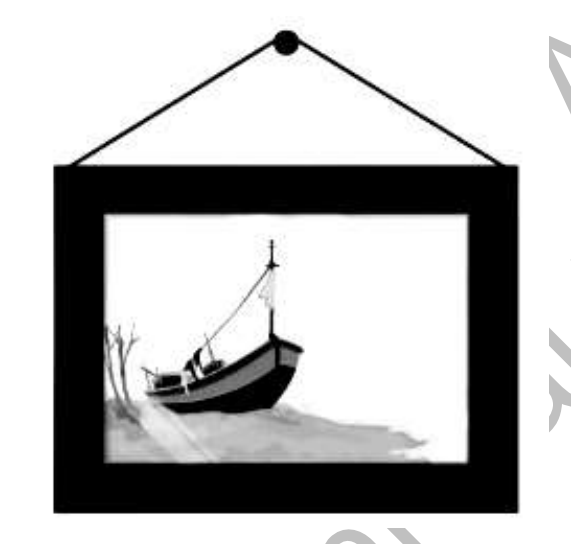
A hanging picture frame is in a state of static equilibrium. The picture frame has a mass of 0.3 kg0.3\text{ kg} and is suspended from a single point by a thin wire.
If a small object of 0.1 kg0.1\text{ kg} is hung at any one corner from the bottom of the picture frame, then explain how the addition of the small object affects the balance of these forces and the stability of the picture frame.
Diagram for Q.2
📋 Official Checking Hints (Marking Scheme):
  • 1 mark for explaining that hanging the 0.1 kg mass at one corner creates an unbalanced torque (moment) and disturbs the static equilibrium.
  • 1 mark for stating that the centre of gravity (CoG) of the picture frame shifts towards the weighted corner.
  • 1 mark for explaining that the frame tilts towards the weighted corner until the new centre of gravity aligns vertically below the suspension point, reducing its initial balanced stability.
1.Disturbance of Equilibrium (Unbalanced Torque): Initially, the picture frame is in static equilibrium because its centre of gravity lies vertically below the single suspension point. Hanging a 0.1 kg0.1\text{ kg} object at one bottom corner introduces an additional downward weight (W=mg=1 NW = mg = 1\text{ N}) at a distance from the line of action of tension, creating an unbalanced torque.
2.Shift in Centre of Gravity: The combined centre of gravity of the frame-and-mass system shifts away from the geometric centre towards the corner where the 0.1 kg0.1\text{ kg} mass is attached.
3.Effect on Position and Stability: Due to the unbalanced moment and shifted centre of gravity, the picture frame tilts downwards on the weighted side until the new centre of gravity comes to rest vertically below the point of suspension.
2025 Syllabus Outcome (4.2.2): solve word problems related to the principle of moments;
A uniform metre rule is pivoted at the 50 cm mark. A 4 N weight hangs at the 20 cm mark. Where should a 6 N weight be suspended to balance the rule horizontally?
Key Formula: F₁ × d₁ = F₂ × d₂
Anticlockwise moment = 4 N × (50 - 20) cm = 120 N·cm. For balance, 6 N × d₂ = 120 N·cm => d₂ = 20 cm to the right of pivot (at the 70 cm mark).
2025 Syllabus Outcome (4.1.3): solve word problems related to the moment of force or torque = force × perpendicular distance from the pivot to the line of action of force;
If a force of 4 N4\text{ N} is applied by a student on a door handle and the moment of force is 16 Nm16\text{ Nm}, then the distance of the pivot from the point of applied force is
From τ=F×d\tau = F \times d, the moment arm (perpendicular distance from the pivot) is d=τF=16 Nm4 N=4 md = \frac{\tau}{F} = \frac{16\text{ Nm}}{4\text{ N}} = 4\text{ m}.
2025 Syllabus Outcome (4.1.3): solve word problems related to the moment of force or torque = force × perpendicular distance from the pivot to the line of action of force;
If a force of 10 N10\text{ N} is acting on a body along the x-axis, then the value of this force acting on the y-axis will be
A force acting purely along the x-axis has no component along the perpendicular y-axis (Fy=Fsin⁡(0∘)=0 NF_y = F \sin(0^{\circ}) = 0\text{ N}).
UNIT 5 • 2 NUMERICAL PROBLEMS

Unit 5: Deformation of Solids — Worked Numericals

2025 Syllabus Outcome (5.1.4): solve word problems using the relation k = F/x;
A helical spring of unstretched length 15 cm extends to 21 cm when a load of 12 N is suspended from it. Calculate its spring constant k in N/m.
Key Formula: k = F / x
Extension x = 21 cm - 15 cm = 6 cm = 0.06 m. Therefore k = 12 N / 0.06 m = 200 N/m.
2025 Syllabus Outcome (5.1.5): describe applications of Hook’s law in measuring instruments such as spring scale, galvanometer, and balance wheel of mechanical clock;
If two metallic spheres have an equal mass of 10 kg10\text{ kg} each and the distance between their centres is 0.5 m0.5\text{ m}, then the gravitational force of attraction between the spheres will be
(Note: The value of the Gravitational constant is 6.67×10⁻¹¹ Nm2/kg26.67 \times 10^{-11}\text{ Nm}^2/\text{kg}^2.)
By Newton's law of universal gravitation, F=Gm1m2r2=6.67×10−11×10×10(0.5)2=6.67×10−90.25=2.668×10⁻⁸ NF = \frac{Gm_1m_2}{r^2} = \frac{6.67 \times 10^{-11} \times 10 \times 10}{(0.5)^2} = \frac{6.67 \times 10^{-9}}{0.25} = 2.668 \times 10^{-8}\text{ N}.
UNIT 6 • 10 NUMERICAL PROBLEMS

Unit 6: Work, Energy and Power — Worked Numericals

2025 Syllabus Outcome (6.3.3): solve word problems related to the kinetic and potential energy;
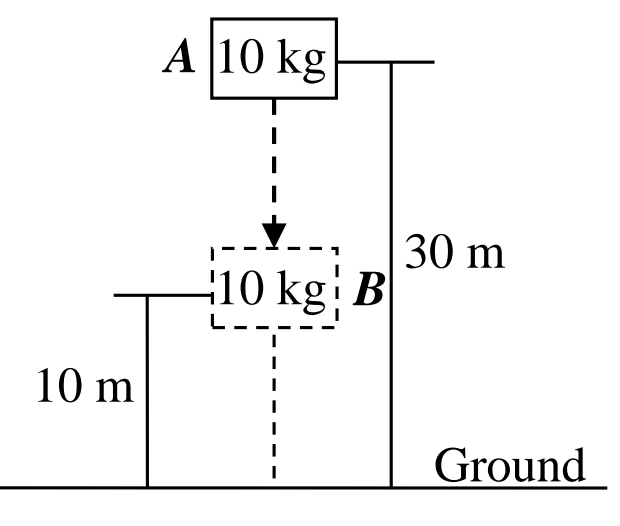
The diagram shows a block is dropped from a point A and moves to a point B.
i.Calculate the change in potential energy (P.E.) of the block at point B with respect to ground. (3 Marks)
ii.Calculate the velocity of the block when it reaches to the point B. (3 Marks)
(Note: Take the value of acceleration due to gravity 'gg' as 10 m/s210\text{ m/s}^2.)
Diagram for Q.7.a
📋 Official Checking Hints (Marking Scheme):
  • 1 mark for extracting the correct data: m = 10 kg, g = 10 m/s², vertical drop h = 30 m - 10 m = 20 m.
  • 1 mark for the correct potential energy formula: P.E. = mgh.
  • 1 mark for the correct change in potential energy from A to B: ΔP.E. = 10 × 10 × 20 = 2000 J.
  • 1 mark for equating loss in P.E. to gain in K.E. (K.E. = P.E.) or using 2gh = v_f² - v_i².
  • 1 mark for writing K.E. = ½mv² (or substituting into 2gh = v_f²).
  • 1 mark for the correct velocity at point B: v = √(2 × 10 × 20) = √400 = 20 m/s.
Given Data:
Mass of block (mm) = 10 kg10\text{ kg}
Height at point A (hAh_A) = 30 m30\text{ m}
Height at point B (hBh_B) = 10 m10\text{ m}
Vertical distance fallen from A to B (h=hA−hBh = h_A - h_B) = 30 m−10 m=20 m30\text{ m} - 10\text{ m} = 20\text{ m}
Acceleration due to gravity (gg) = 10 m/s210\text{ m/s}^2
**(i) Change in Potential Energy (ΔP.E.\Delta P.E.) of the block from A to B:**
ΔP.E.=mgh=10 kg×10 m/s2×(30−10) m=10×10×20=2000 J\Delta P.E. = mgh = 10\text{ kg} \times 10\text{ m/s}^2 \times (30 - 10)\text{ m} = 10 \times 10 \times 20 = 2000\text{ J}
*(Note: The potential energy remaining at point B with respect to the ground is P.E.B=mghB=10×10×10=1000 JP.E._B = mgh_B = 10 \times 10 \times 10 = 1000\text{ J}, and the loss/change in P.E. from A to B is 3000 J−1000 J=2000 J3000\text{ J} - 1000\text{ J} = 2000\text{ J}.)*
**(ii) Velocity of the block at point B (vfv_f):**
By conservation of energy (Gain in K.E.=Loss in P.E.\text{Gain in } K.E. = \text{Loss in } P.E.) or the third equation of motion (2gh=vf2−vi22gh = v_f^2 - v_i^2 with vi=0v_i = 0):
12mvf2=2000 J  ⟹  vf2=2×200010=400\frac{1}{2}mv_f^2 = 2000\text{ J} \implies v_f^2 = \frac{2 \times 2000}{10} = 400
vf=400=20 m/sv_f = \sqrt{400} = 20\text{ m/s}.
2025 Syllabus Outcome (6.6.2): solve word problems related to the concept of power;
Sara has mass of 30 kg. While running in the playground, she accelerates from 2 m/s to 4 m/s in 5 s. Calculate the power consumed in the given situation.
📋 Official Checking Hints (Marking Scheme):
  • Formula F = ma substituted with m = 30 kg.
  • Correct acceleration calculation and units.
Given data:
Mass (mm) = 30 kg
Initial velocity (viv_i) = 2 m/s
Final velocity (vfv_f) = 4 m/s
Time (tt) = 5 s
Work done (WW) = Change in kinetic energy (ΔKE\Delta KE)
W=12mvf2−12mvi2W = \frac{1}{2} m v_f^2 - \frac{1}{2} m v_i^2
W=12(30)(4)2−12(30)(2)2W = \frac{1}{2} (30) (4)^2 - \frac{1}{2} (30) (2)^2
W=15(16)−15(4)W = 15(16) - 15(4)
W=240−60=180W = 240 - 60 = 180 J
Power (PP) = Wt\frac{W}{t}
P=180 J5 s=36P = \frac{180 \text{ J}}{5 \text{ s}} = 36 W
2025 Syllabus Outcome (6.3.3): solve word problems related to the kinetic and potential energy;
Calculate the kinetic energy of a 0.5 kg bullet moving with a velocity of 500 m/s.
Key Formula: E_k = ½mv²
E_k = 0.5 × 0.5 kg × (500 m/s)² = 0.25 × 250,000 = 62,500 J = 62.5 kJ.
2025 Syllabus Outcome (6.3.3): solve word problems related to the kinetic and potential energy;
If the kinetic energy of a 200 kg200\text{ kg} object is 10,000 J10,000\text{ J}, then the velocity of the object will be
From K.E.=12mv2K.E. = \frac{1}{2}mv^2, we have v=2×K.E.m=2×10000200=100=10.0 m/sv = \sqrt{\frac{2 \times K.E.}{m}} = \sqrt{\frac{2 \times 10000}{200}} = \sqrt{100} = 10.0\text{ m/s}.
2025 Syllabus Outcome (6.1.2): solve word problems related to workdone;
A tugboat applies a force of 100 N100\text{ N} to tow a container ship from the shore to the deep sea. The rope that connects the tugboat to the ship is parallel to the surface of the water.
If the tugboat displaces the container ship by 500 m500\text{ m}, then the amount of work done by the tugboat will be
(Note: Suppose that the seawater current is negligible.)
Since the towing force acts parallel to the displacement, W=F×d=100 N×500 m=50,000 JW = F \times d = 100\text{ N} \times 500\text{ m} = 50,000\text{ J}.
2025 Syllabus Outcome (6.6.2): solve word problems related to the concept of power;
An electric heater of 500 W500\text{ W} consumes 50 J50\text{ J} of energy to warm a room. The time required by the heater to warm the room will be
From P=EtP = \frac{E}{t}, the time required is t=EP=50 J500 W=0.1 st = \frac{E}{P} = \frac{50\text{ J}}{500\text{ W}} = 0.1\text{ s}.
2025 Syllabus Outcome (6.1.2): solve word problems related to workdone;
A car travels a distance of 150 m in the direction of a constant force of 50 N. The work done on the car is
Work done (WW) is given by the formula W=F×dW = F \times d. Here, Force F=50 NF = 50\text{ N} and distance d=150 md = 150\text{ m}. W=50 N×150 m=7500 JW = 50\text{ N} \times 150\text{ m} = 7500\text{ J}.
2025 Syllabus Outcome (6.5.3): explain that a system cannot have an efficiency of 100%;
If a loading truck has an output of 3600 J and its efficiency is 50%, then the input provided to the truck will be
Efficiency = (Output Energy/Input Energy)×100(\text{Output Energy} / \text{Input Energy}) \times 100. Rearranging for Input Energy: Input=(Output/Efficiency)×100=(3600/50)×100=7200 J\text{Input} = (\text{Output} / \text{Efficiency}) \times 100 = (3600 / 50) \times 100 = 7200\text{ J}.
2025 Syllabus Outcome (6.3.3): solve word problems related to the kinetic and potential energy;
The kinetic energy of a 0.5 kg bullet moving with velocity of 500 m/s is
Kinetic Energy (KEKE) = 12mv2=12×0.5 kg×(500 m/s)2=0.25×250000=62500 J\frac{1}{2} m v^2 = \frac{1}{2} \times 0.5\text{ kg} \times (500\text{ m/s})^2 = 0.25 \times 250000 = 62500\text{ J}.
2025 Syllabus Outcome (6.6.3): explore different innovative energy transfer devices used in transportation and communication.
If a person releases 500 J of energy by walking along a track in 125 seconds, then the required average muscular power is
Power (PP) = Energy / Time=500 J/125 s=4.0 W\text{Energy / Time} = 500\text{ J} / 125\text{ s} = 4.0\text{ W}.
UNIT 7 • 4 NUMERICAL PROBLEMS

Unit 7: Pressure — Worked Numericals

2025 Syllabus Outcome (7.4.2): discuss the use of Pascal’s law (including hydraulic press and hydraulic brakes on vehicles);
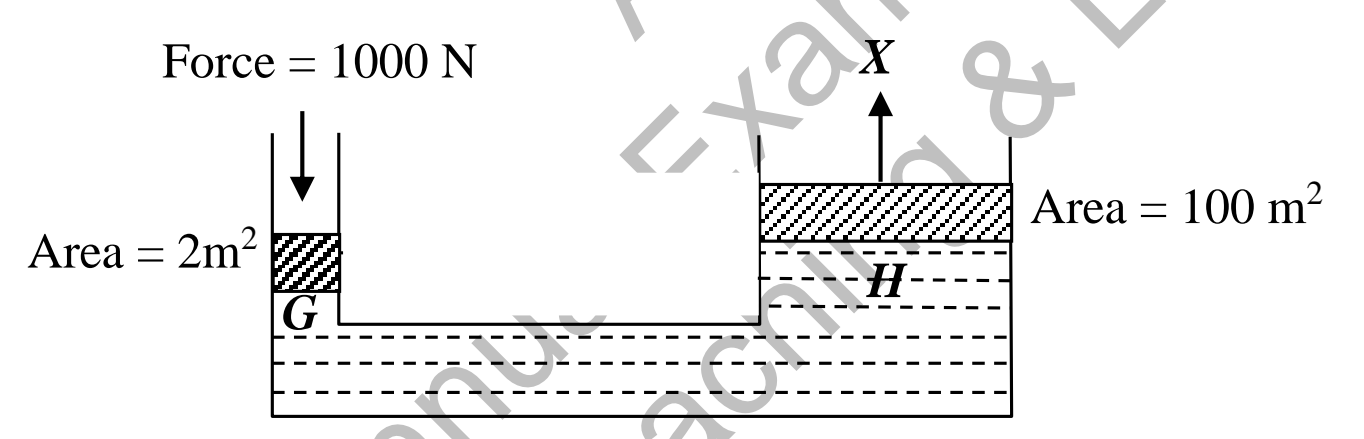
The given figure shows the brake system of a vehicle.
i.Name the law which is used in the given brake system. (1 Mark)
ii.Calculate the pressure exerted by the liquid at G and H and the force that is applied at X. (5 Marks)
Diagram for Q.7.b
📋 Official Checking Hints (Marking Scheme):
  • 1 mark for correctly identifying Pascal's law.
  • 1 mark for calculating pressure at G: P_G = F₁ / A₁ = 1000 N / 2 m² = 500 N/m² (or 500 Pa).
  • 1 mark for stating the pressure at H: P_H = 500 N/m² (or 500 Pa) because pressure is transmitted equally throughout an enclosed fluid.
  • 1 mark for using the correct transmitted pressure value P = 500 N/m².
  • 1 mark for writing the correct formula for force: F = P × A (or F₂ = P_H × A₂).
  • 1 mark for calculating the correct force at X: F = 500 × 100 = 50,000 N.
(i) Name of the law:
The law used in the hydraulic brake system of a vehicle is Pascal's law.
(ii) Pressure at G, Pressure at H, and Force at X:
•**Pressure exerted at piston G (PGP_G):**
PG=Force (F1)Area (A1)=1000 N2 m2=500 N/m2 (or 500 Pa)P_G = \frac{\text{Force }(F_1)}{\text{Area }(A_1)} = \frac{1000\text{ N}}{2\text{ m}^2} = 500\text{ N/m}^2\text{ (or }500\text{ Pa)}
•**Pressure exerted at piston H (PHP_H):**
According to Pascal's law, pressure applied to an enclosed liquid is transmitted undiminished to every portion of the liquid. Therefore:
PH=PG=500 N/m2 (or 500 Pa)P_H = P_G = 500\text{ N/m}^2\text{ (or }500\text{ Pa)}
•**Force applied at X (F2F_2):**
Since PH=F2A2P_H = \frac{F_2}{A_2}:
F2=PH×A2=500 N/m2×100 m2=50,000 NF_2 = P_H \times A_2 = 500\text{ N/m}^2 \times 100\text{ m}^2 = 50,000\text{ N}.
2025 Syllabus Outcome (7.4.4): solve word problems related to the relationship between pressure, depth and liquid density;
If the density of water is 1,000 kg/m3, then calculate the depth of water in a dam when the pressure at the bottom is 1,00,000 Pa. (Note: Take the value of acceleration due to gravity as 9.8 m/s2.)
📋 Official Checking Hints (Marking Scheme):
  • Formula: P = ρgh rearranged to h = P / (ρg)
  • Substitution: h = P / (1000 * 9.8)
  • Calculation of depth h with metres (m) unit.
Given data:
Density of water (ρ\rho) = 1000 kg/m31000 \text{ kg/m}^3
Pressure (PP) = 100,000 Pa100,000 \text{ Pa}
Acceleration due to gravity (gg) = 9.8 m/s29.8 \text{ m/s}^2
Formula:
P=ρghP = \rho g h
Calculation:
100,000=1000×9.8×h100,000 = 1000 \times 9.8 \times h
100,000=9800×h100,000 = 9800 \times h
h=100,0009800h = \frac{100,000}{9800}
h≈10.2h \approx 10.2 m
2025 Syllabus Outcome (7.2.2): explain that pressure varies with force and area with the help of real-life examples;
A parcel box of weight 500 N rests on a table with a base contact area of 0.50 m². Calculate the pressure exerted on the table.
Key Formula: P = F / A
P = 500 N / 0.50 m² = 1000 Pa.
2025 Syllabus Outcome (7.2.2): explain that pressure varies with force and area with the help of real-life examples;
A parcel box of weight 500 N is placed on a table. If the area of the bottom of the box is measured as 0.50 m2, then the pressure exerted by the box on the table will be
Pressure (PP) = Force/Area=500 N/0.50 m2=1000 Pa\text{Force} / \text{Area} = 500\text{ N} / 0.50\text{ m}^2 = 1000\text{ Pa}.
UNIT 8 • 3 NUMERICAL PROBLEMS

Unit 8: Thermal Physics — Worked Numericals

2025 Syllabus Outcome (8.3.3): explain that a physical property that varies with temperature can be used as a criteria to measure temperature;
Convert a temperature of 20°C into the Kelvin (K) and Fahrenheit (°F) scales.
Key Formula: T(K) = T(°C) + 273; T(°F) = 1.8 T(°C) + 32
T(K) = 20 + 273 = 293 K; T(°F) = (1.8 × 20) + 32 = 68°F.
2025 Syllabus Outcome (8.3.2): convert temperature from one scale to another (Fahrenheit, Celsius and Kelvin scales);
If the temperature of a substance is 20∘C20^\circ\text{C}, then its temperature in Kelvin scale will be
Converting from Celsius to Kelvin uses T(K)=T(∘C)+273=20+273=293 KT(\text{K}) = T(^\circ\text{C}) + 273 = 20 + 273 = 293\text{ K}.
2025 Syllabus Outcome (8.3.3): explain that a physical property that varies with temperature can be used as a criteria to measure temperature;
If the temperature of a substance is 20°C, then its temperature in Kelvin scale will be
T(K)=T(°C)+273=20+273=293 KT(\text{K}) = T(°\text{C}) + 273 = 20 + 273 = 293\text{ K}.
UNIT 9 • 2 NUMERICAL PROBLEMS

Unit 9: Transfer of Thermal Energy — Worked Numericals

2025 Syllabus Outcome (9.1.4): solve word problems related to the thermal conductivity of solid conductors;
A copper rod is 20 m long with the cross-sectional area of 4 m2. If its two ends are kept at temperatures 200oC and 300oC respectively, calculate the amount of heat flowing across the rod in one second. (Note: Take the co-efficient of thermal conductivity as 386.4 J/m.K.s.)
📋 Official Checking Hints (Marking Scheme):
  • Correct formula: Q/t = k * A * (T2 - T1) / L
  • Correct substitution: Q/t = 386.4 * 4 * (300 - 200) / 20
  • Correct calculation and units: Rate of heat flow = 7728 J/s (or Watts)
Given data:
Length (LL) = 20 m
Area (AA) = 4 m2\text{m}^2
Temperature T1T_1 = 200 ∘C^{\circ}\text{C}, T2T_2 = 300 ∘C^{\circ}\text{C}
Temperature difference (ΔT\Delta T) = 300−200=100300 - 200 = 100 K
Time (tt) = 1 s
Coefficient of thermal conductivity (kk) = 386.4 J/m⋅K⋅s\text{J/m}\cdot\text{K}\cdot\text{s}
Formula:
Qt=k⋅A⋅(T2−T1)L\frac{Q}{t} = \frac{k \cdot A \cdot (T_2 - T_1)}{L}
Calculation:
Q1=386.4×4×10020\frac{Q}{1} = \frac{386.4 \times 4 \times 100}{20}
Q1=15456020=7728\frac{Q}{1} = \frac{154560}{20} = 7728 J/s
Amount of heat flowing in one second (QQ) = 7728 J
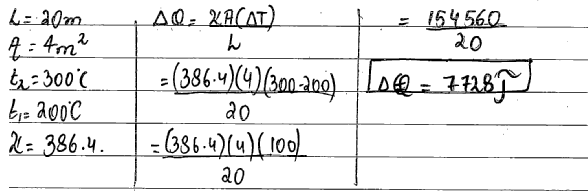
Authentic E-Marking Better Candidate Calculation Script:
Better candidate calculation for Q.5
2025 Syllabus Outcome (9.1.4): solve word problems related to the thermal conductivity of solid conductors;
A concrete wall of thickness 0.25 m and area 10 m² has an inside temperature of 25°C and outside temperature of 5°C. If k = 0.8 W/m·K, find the rate of heat conduction.
Key Formula: Q/t = kAΔT / L
Q/t = (0.8 × 10 × (25 - 5)) / 0.25 = 160 / 0.25 = 640 W.
UNIT 10 • 1 NUMERICAL PROBLEMS

Unit 10: Nature of Science — Worked Numericals

2025 Syllabus Outcome (10.3.1): define different scientific methods (hypothesis, theory and law) for carrying out investigations;
In a controlled experiment verifying T ∝ √l for a pendulum, the length is quadrupled (4l). By what factor does the predicted time period change according to the scientific model?
Key Formula: T₂ / T₁ = √(l₂ / l₁)
T₂ / T₁ = √(4l / l) = 2. The time period doubles.