Physics — Chapter-Wise Extended Response Questions (ERQs)
Practice 4–6 mark structured derivations, graph interpretations, and multi-part problems from 2024 & 2025 Annual Paper II, Model Paper II, and curriculum banks with official marking schemes and E-Marking scripts.
Select a Chapter (or Browse All Below)
Click any unit card to filter to that specific chapter, or use the search bar to find any concept, formula, or SLO code.
Unit 1: Measurement
Unit 2: Kinematics

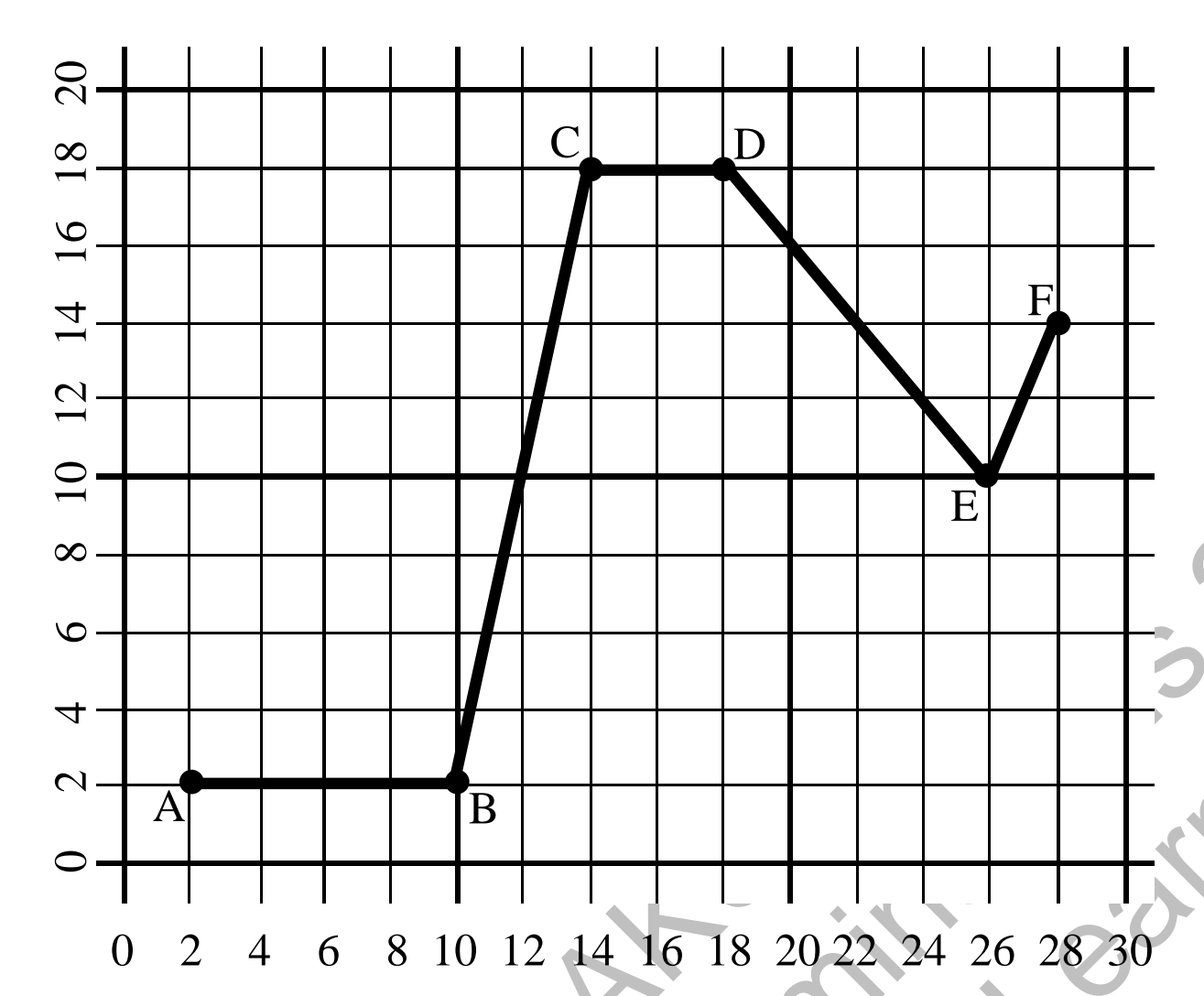
- 1 mark for both stationary intervals: Distance covered during A to B = 0 m AND during C to D = 0 m.
- 1 mark for distance covered during B to C: 18 m - 2 m = 16 m.
- 1 mark for distance covered during D to E: 18 m - 10 m = 8 m.
- 1 mark for distance covered during E to F: 14 m - 10 m = 4 m.
- 1 mark for Total Distance covered = 0 + 16 + 0 + 8 + 4 = 28 m.
- 1 mark for Total Displacement covered = 0 + 16 + 0 + (-8) + 4 = 12 m (or final position 14 m minus initial position 2 m = 12 m).
Examiner Commentary (Better Responses): Better responses accurately read the vertical axis values for each segment (0 m, 16 m, 0 m, 8 m, 4 m), summed their magnitudes to get 28 m for total distance, and accounted for the negative direction from D to E (-8 m) to find 12 m for total displacement.
- Using appropriate equation of motion: v_f^2 = v_i^2 + 2gh or v_f = gt
- Correct substitution and final numerical answer with units (m/s).
- Identifying given data (v_i = 0, v_f = 80 m/s, S = 900 m)
- Using third equation of motion to find acceleration
- Correct value of acceleration with units
- Using first or second equation of motion to find time
- Correct value of time with units
Unit 3: Dynamics
- 1 mark for extracting and writing the correct given data (v_i = 0 m/s, v_f = 25 m/s, F = 100 N, t = 5 s).
- 1 mark for finding the correct acceleration using a = (v_f - v_i)/t = (25 - 0)/5 = 5 m/s².
- 1 mark for writing the correct formula for mass: m = F / a (from F = ma).
- 1 mark for calculating mass with correct SI unit: m = 100 / 5 = 20 kg.
- 1 mark for writing the correct formula for momentum: P = m × v_f (or P = F × t).
- 1 mark for calculating momentum with correct SI unit: P = 20 × 25 = 500 kg·m/s (or 500 N·s).
Examiner Commentary (Better Responses): Better responses extracted all given data with SI units, calculated acceleration a = 5 m/s², found m = F/a = 20 kg, and computed P = mv = 500 kg·m/s clearly.
- Statement: Acceleration is directly proportional to applied net force and inversely proportional to mass.
- Mathematical derivation showing a ∝ F and a ∝ 1/m leading to F = ma.
- Definition of unit force: 1 Newton is force required to produce 1 m/s² acceleration in 1 kg mass.
Unit 4: Turning Effect of Forces
Unit 5: Deformation of Solids
Unit 6: Work, Energy and Power

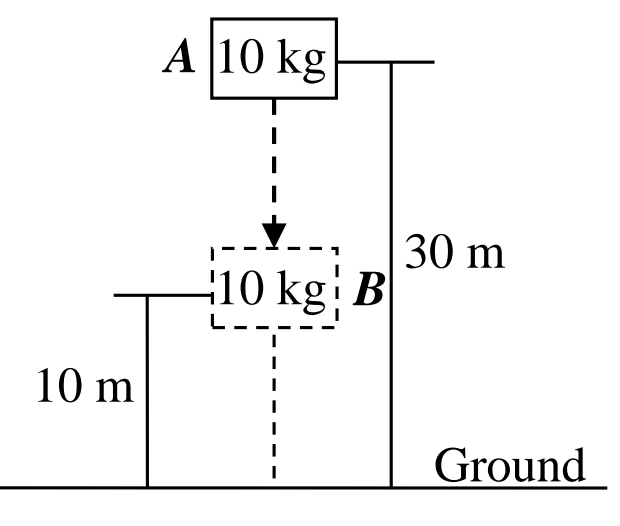
- 1 mark for extracting the correct data: m = 10 kg, g = 10 m/s², vertical drop h = 30 m - 10 m = 20 m.
- 1 mark for the correct potential energy formula: P.E. = mgh.
- 1 mark for the correct change in potential energy from A to B: ΔP.E. = 10 × 10 × 20 = 2000 J.
- 1 mark for equating loss in P.E. to gain in K.E. (K.E. = P.E.) or using 2gh = v_f² - v_i².
- 1 mark for writing K.E. = ½mv² (or substituting into 2gh = v_f²).
- 1 mark for the correct velocity at point B: v = √(2 × 10 × 20) = √400 = 20 m/s.
Examiner Commentary (Better Responses): Better responses subtracted the heights to find h = 30 - 10 = 20 m, calculated P.E. = mgh = 10(10)(20) = 2000 J, and applied 2gh = v_f² - v_i² (or ½mv² = P.E.) to obtain v_f = √400 = 20 m/s.
- Formula F = ma substituted with m = 30 kg.
- Correct acceleration calculation and units.
- Definition of renewable sources of energy
- Four examples of renewable sources of energy
- Definition of non-renewable sources of energy
- Four examples of non-renewable sources of energy
Unit 7: Pressure

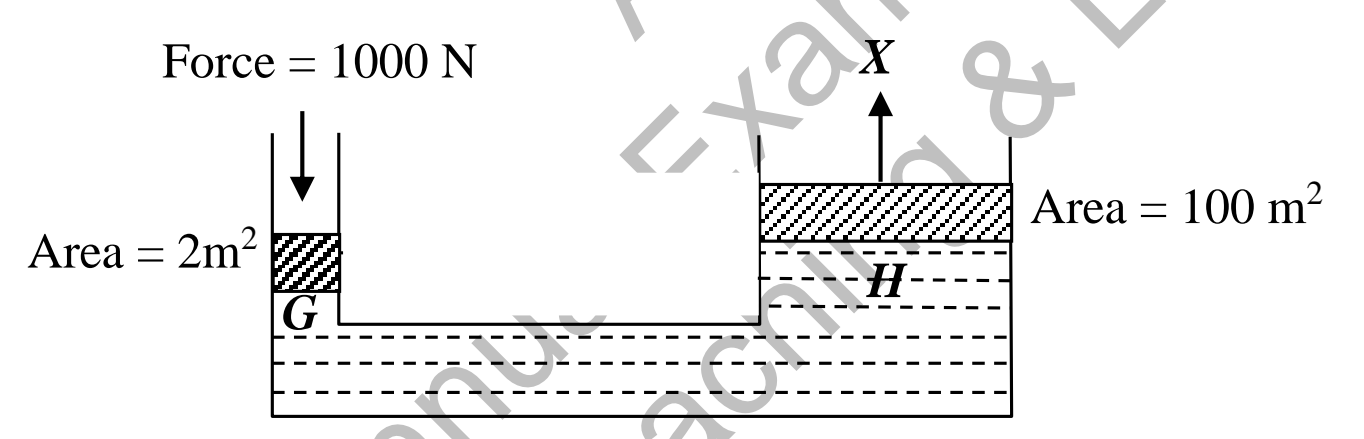
- 1 mark for correctly identifying Pascal's law.
- 1 mark for calculating pressure at G: P_G = F₁ / A₁ = 1000 N / 2 m² = 500 N/m² (or 500 Pa).
- 1 mark for stating the pressure at H: P_H = 500 N/m² (or 500 Pa) because pressure is transmitted equally throughout an enclosed fluid.
- 1 mark for using the correct transmitted pressure value P = 500 N/m².
- 1 mark for writing the correct formula for force: F = P × A (or F₂ = P_H × A₂).
- 1 mark for calculating the correct force at X: F = 500 × 100 = 50,000 N.
Examiner Commentary (Better Responses): Better responses named Pascal's law, computed P_G = 1000 / 2 = 500 N/m², explained that P_H = 500 N/m² by Pascal's law, and solved F = P × A = 500 × 100 = 50,000 N with proper units.
- Liquid pressure increases linearly with depth: P = ρgh.
- Wedge shape provides greater thickness and strength at the bottom to withstand immense hydrostatic pressure.
- Formula: P = ρgh rearranged to h = P / (ρg)
- Substitution: h = P / (1000 * 9.8)
- Calculation of depth h with metres (m) unit.
- Description of forces acting on a partially immersed body (Weight downwards, Upthrust upwards)
- Description of forces acting on a completely immersed body (Weight downwards, Upthrust/Buoyant force upwards, and potentially tension/normal force)